
One of the major emerging filmmakers of Hong Kong’s 80’s New Wave alongside the likes of Wong Kar-Wai and John Woo was the comparatively less-renowned (at least to world cinema) Ann Hui. For forty years now she’s had an interesting career that has spanned all kinds of genres from documentary to romance to thriller to martial arts film and is known for being an intensely socially conscious filmmaker. Early in her career she made an unofficial trilogy dealing with the effects and aftermath of the Vietnam War on the Vietnamese people, the last of which was 1982’s Boat People.
It would appear the film doesn’t have much to do with Hong Kong, although most of the major actors are from Hong Kong, which is a touch problematic for such a Vietnamese story. It’s actually about a Japanese photojournalist Akutagawa, played by George Lam, documenting the situation in and around Da Nang in the wake of the end of the war. In his experiences with both jaded military officials and the desperate poor seeking to escape the now communist country, he is unable to avoid the politics and becomes enveloped in their plight.
The movie is extremely unrelenting and unsurprisingly was controversial for this. The first scene shows a class of children in a New Economic Zone singing the praises of Ho Chi Minh at the behest of government officials. The lives of ordinary people in Vietnam are seen to be quite miserable throughout. A girl that Akutagawa befriends Cam Nuong (Season Ma) lives in a rundown house without a bathroom, her mother a secret prostitute. Protesters are seen beaten up by state police, unexploded bombs threaten the lives of children, and the colloquially named “chicken farm” is where the fresh bodies of executed dissidents are rummaged through for valuables. These aspects of post-war Vietnam are peeled back gradually for Akutagawa, who initially has an open mind in his assignment.
 |
A lot of it might feel like overkill, though Hui insisted it wasn’t, based on interviews she conducted for her earlier documentary on the subject. In particular a scene where the Coast Guard attacks a small refugee boat was directly inspired by tactics reported on by international press. But some level of bias can’t be denied, especially given the film was partially financed by and shot in China -the reason why one of Hui’s otherwise reliable actors, Chow Yun-Fat, turned down a role (which eventually went to a young Andy Lau). Some western critics derided it as propaganda, while others read into it an allegory for the negotiations between Britain and China over the sovereignty of Hong Kong (something which wouldn’t be finalized until fifteen years later).
Regardless of its possible exaggerations and political aims, it’s a good demonstration of Hui’s abilities as a filmmaker. Her background in documentary is very palpable in her very naturalistic pacing, though occasionally her shooting, lighting, and editing veers into style. In fact it’s almost jarring when some of the more dramatic plot beats happen, reminding you the film has a story as well as a narrative.
Lam and Lau in particular give very good performances. If I have issues with the film it might be in the placement of some of the violent moments, which can read a bit like shock value, regardless of whether or not they’re accurate. I also think it would have helped to have Vietnamese representation both on screen and in the creative department to lend the film more weight. It’s worth noting too a lot of the dialogue is dubbed, some quite poorly so (as in the case of Cam Nuong’s younger brother), which may just be a period or geographic trend I’m not aware of, though it is on occasion distracting. Nevertheless, the movie is an interesting portrait of a time and place not often covered on film, certainly not for Westerners -who could do to remember it wasn’t just the Americans who lost in the Vietnam War.
Criterion Recommendation: The Farewell (2018)
Criterion Recommendation: The Farewell (2018)
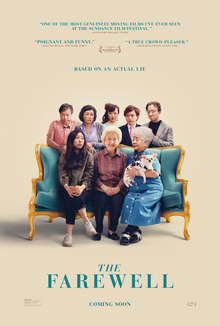 |
We’re having an important conversation now around Asian-American representation in the film industry. And there aren’t a lot of Asian-American films in the Criterion Collection. If you ask me, Minari deserves to go in there as quickly as The Irishman, Marriage Story, and One Night in Miami have, but Lulu Wang’s The Farewell belongs in that club just as much, if not more so. A compelling and tender look at the cultural divide between the Chinese diaspora and the homeland that is likewise very rich in themes of character and family, The Farewell is a beautiful movie about a beloved matriarchs’ impending death and her relationship with her American granddaughter. Wang’s direction is sublime and emotional as it zeroes in on an atmosphere of grief but also little joys. And the performances she elicits from Awkwafina and Zhao Shuzhen are impeccably wonderful. It presents what might seem like a bewildering tradition in a fair and nuanced way, and as an exemplar of cross-cultural exposure and education, it’s one of the finest films there is.
Support me on Patreon: https://www.patreon.com/JordanBosch
Follow me on Twitter: https://twitter.com/Jordan_D_Bosch
Letterboxd: https://letterboxd.com/jbosch/
Comments
Post a Comment