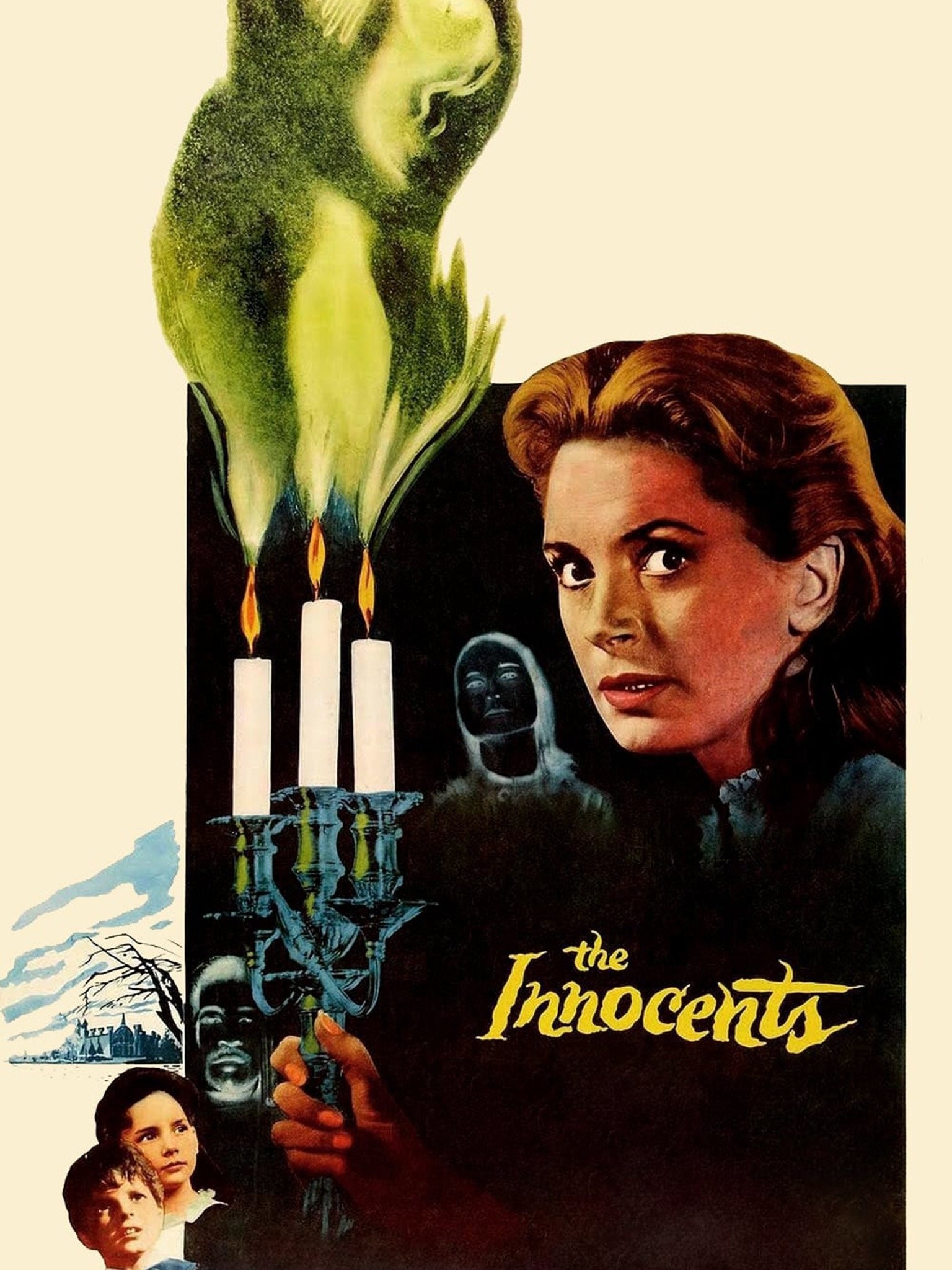
The ‘creepy child’ trope in horror most likely originates in Henry James’s The Turn of the Screw, one of the great classic ghost stories and works of psychological horror. But it is one thing to read about the eerie behaviour of two children, it is another thing to see it in practice -hence why the novel made for a popular adaptation on stage. However it didn’t make it to the silver screen until 1961, when playwright William Archibald adapted his own version, renamed The Innocents, with Truman Capote and director Jack Clayton produced a truly haunting work. And though movies like The Bad Seed and Village of the Damned had primed the pump, what we think of when we think of creepy children as a horror movie device perhaps found its first footing here. The spectre of Damien from The Omen, the kid from Insidious, Brightburn and so many other freaky manipulative movie children can be found in little Miles, however innocent he may or may not be.
That is of course the other great source of horror in this movie -the uncertainty over whether the hauntings are real or just some disturbed hallucination of the protagonists’ mind. It is the same theme explored so vividly in Shirley Jackson’s The Haunting of Hill House and its masterful movie adaptation a couple years after this one (and of course both stories formed the loose the basis for seasons of Mike Flanagan’s Haunting series). The Innocents is gripping on a similar level, though very much does its own thing in regards to the hypnotic, chilling aspects of this story. The hair on my back stood on end multiple times through this film -its results are still very effective.
Deborah Kerr stars as Miss Giddens (the character is in fact unnamed in the book) who is hired to be the new governess at Bly Manor for the orphaned niece and nephew of a wealthy aristocrat who very openly wants nothing to do with them and gives her great freedom in her responsibility over them. She goes to Bly, is very charmed by the precocious Flora (a young Pamela Franklin) while her brother Miles (Martin Stephens) is away at school. However Miles soon returns unexpectedly, having been expelled for reasons housekeeper Mrs. Grose (Megs Jenkins) and other staff who knew him can’t fathom. He appears to be perfectly polite if a tad mischievous. Shortly after he returns Miss Giddens begins observing strange behaviour in the children -unusual talk and inappropriate attitudes towards her, and further begins seeing and hearing apparitions of the children's former governess Miss Jessel -who died suddenly the previous year- and the valet Quint, also dead, with whom she had been having an affair, and begins to grow paranoid over the influence she perceives them having on the children.
The way that Clayton depicts these hauntings is probably the most successful aspect of the movie, each sequence where Miss Giddens witnesses them is appropriately eerie and even downright chilling. The black and white photography is critical, the contrasts and shadows isolating Miss Giddens against her foreboding surroundings highlighting the mystery of the darkness. One seemingly mild encounter sees Miss Giddens come across the spirit of Miss Jessel while playing hide and seek with the kids before bed -a woman walks from the shadows into an adjoining room just ahead of Miss Giddens -nothing but a silhouette and yet the instant presence is creepy. Lighting and composition become fundamental tools as in a later scene where she is wandering through the house and the outlines of objects stand out in suspicious ways, edited together with inserts of the object sources of some anxiety or noise Miss Giddens is experiencing. Her first prominent ghostly encounter is when she sees Quint staring at her through a window, his visage fuzzy as though looking through a fishbowl -though the wicked smile of actor Peter Wyngarde leaves such a menacing impression. But then there are scenes where the apparitions are more corporeal -Miss Jessel specifically. Yet I love that for these Clayton keeps her at a distance, whether out on a patch of weeds on the lake seemingly locking eyes with Flora or at the other side of a schoolroom weeping. No close-up shots or pan-ins; we can see her but she is still removed, and all the more eerie for it.
Kerr is really quite good in selling the terror and the hysteria slowly overwhelming her. The story has often being interpreted as a metaphor for sexual repression, and while it is not as obvious as in the story it is still there in things like the leering way that face of Quint looks at Miss Giddens and the troubling intonations of Miles towards her that leads to Miss Giddens suspecting these ghosts are possessing the children. Why else would Miles be downright flirtatious in his attitude around her? Of course these details are highly subjective, and part of the inherent thrill of reading the story is that question of how much of what she is seeing is just in her head? Are Flora and Mrs. Grose genuinely gaslighting her when they claim they can’t see the woman on the lake? Is Miles’s tone, if not his actual language, really what Miss Giddens perceives it as? It can be tough to articulate these things in a visual medium, but The Innocents does a strong job of it. We never quite leave Miss Giddens’ perspective, and though we might be predisposed to trust in Kerr, her performance grows more desperate and manic as the film goes along -beyond the pale of the high emotions she might express in other melodramas. Subtly, it is a much darker performance than I’ve seen from her, and she handles its complexity beautifully.
Both Stephens and Franklin are haunting as well though -Stephens had already played one creepy child in Village of the Damned and is quite good here at playing another more sinister variation. The nuances in his performance of deceptive politeness really stand out, especially the closer things get to the climax. Meanwhile, Franklin plays several of her scenes like she is proud of some great secret she is withholding, and though ostensibly the nicer of the children there is a touch of apparent cruelty in the extremities of her behaviour in defiance of Miss Giddens, especially concerning the vision out on the lake.
Clayton casts such a strong sense of atmosphere all through the movie -Bly is a bit vague in dimensions compared to a manor such as Hill House but it is still rendered with striking character where need be. The tense mood of the place is relayed through his choices and amplified in the music by Georges Auric and Daphne Oram and the cinematography of the great Freddie Francis who utilizes some really powerful split dioptre shots that train the eye to catch seemingly innocuous parts of the frame. It is perhaps most effective in the scenes where the phantom of Quint appears in the background behind a character in the foreground, through the prism of a glass window making for a surprisingly terrifying effect, especially in the latter case where it is contextualized within a chaotic rant of reprobation from Miles that reads to Miss Giddens as proof positive of the caretaker's control over the young boy. It makes for a stupendously chilling moment.
This film doesn't pull its punches, committing ultimately to both the grim end of the story and its abruptness, both of which are effective shocks that keep the story's chief themes and ideas percolating. The tension boils in tandem with Miss Giddens' apparent desperation and all through Miles's explanation for his expulsion, which at least raises some certainty over his lack of honesty in behaviour. It is curious that approaching the critical moment, Clayton and Francis choose a new vantage for the apparition that could perhaps point towards their credibility. Yet that question is ultimately still kept vague and the mystery over how the ending comes about and Miss Giddens' possible culpability remains, touched by the unsettling final motion of hers, mirroring one of Miles's from earlier in the film that again alludes uneasily to a problematic sexual repression.
It leaves you with a lot to analyze and discuss, as the story does. The Innocents is a superb adaptation not only for this but for how eerily and effectively it translates that mystifying mood. Clayton's work here, alongside that of Francis and Kerr deserves every plaudit. It is a creepier ghost film than most that have been made in more recent years. Miles and Flora, and their potential ghost avatars, are still captivatingly haunting figures -however you read the film, innocents no more.
Support me on Patreon: https://www.patreon.com/JordanBosch
Follow me on Bluesky: https://bsky.app/profile/jordanbosch.bsky.social
Letterboxd: https://letterboxd.com/jbosch
Twitter: https://twitter.com/Jordan_D_Bosch
Comments
Post a Comment