
Sergei Eisenstein made three sound films before his death in 1948 . Only one part of his duology Ivan the Terrible was released publicly in his lifetime -it’s second-half banned by Soviet censors. But his earlier film Alexander Nevsky from 1938 had no such issues -perhaps because while his take on Ivan was more complex, on Nevsky he aligned more strongly with the interests of Stalinist Russian propaganda -though this film was censored for a brief time during the Molotov-Ribbentropp Pact due to its depictions of Germans.
Most historical films of this era, especially those with a nationalist bent, were always more about the political climate they were made within rather than the setting much removed. Even by those standards though, Eisenstein is quite blunt in Alexander Nevsky. Not only are the somewhat anachronistic names of Russia (in lieu of Novgorod) and Germany (rather than the Holy Roman Empire) used, but the Germans are depicted with subtle swastikas in their apparel as are the German Priests in perhaps a jab at the Reichskonkordat -symbols that are a little out of place in the northern European Middle Ages.
Alexander Nevsky, an icon of Russian history, was the Prince of Novgorod, a city-state encompassing a chunk of northwestern Russia. Here he is played by Nikolay Cherkasov as a humble and heroic ruler, principled and just. At the start he turns down the Mongols offer to join their Golden Horde, and later rallies his people to expel the German Teutonic Order when it invades the city of Pskov, culminating in the great Battle of Ice on the frozen Lake Chudskoe -this and its aftermath taking up roughly a third of the runtime.
 |
Eisenstein frames Nevsky as a noble embodiment of the toughness and righteousness of Russia personified -very blatantly so in some places, hence why the movie played well with Stalin. He speaks very poetically of the Russian people, their love of homeland and harsh rebuke of invaders, and it is very clear what exactly Eisenstein is getting at with that latter point. He could see what fascism was doing in Germany and where it was headed, utilizing all his expertise in film language and theory to convey the threat they posed and the necessity of the Russians standing against it, all cloaked in a reenactment of a favourite cultural folk hero and arguably his most definitive legendary victory. Cherkasov curiously resembles in this part Errol Flynn’s dashing impression of Robin Hood, which was that same year released in the United States. Both figures romanticized images of medieval heroes imbued with a modern political or social relevance. Obviously, Eisenstein couldn’t look to that contemporary film for inspiration, but he may well have taken influence from a similar source: Walt Disney, who despite a polar opposite ideology, Eisenstein was unexpectedly a great fan of.
You may see it in the way that he designs the film, with a kind of clean bright imagery to the sets and set-pieces evocative of some of the early Disney fairy tale shorts. That repackaging of mythology in stark terms clearly appealed to Eisenstein, who keeps his aesthetics unencumbered by flashy details and textures. Though the politics are very relevant, it is meant to feel like a distant, idealized world -a story that a nation grew out of and that encapsulates its themes of bravery and fraternity. And very curiously it is a film in which everyone has their place. Nevsky is far too pure to make for a relatable character, so Eisenstein features prominently a couple frenemy soldiers Vasili (Nikolay Okhlopkov) and Gavrilo (Andrei Abrikisov), fighting for the hand of one Olga (Valentina Ivashova), who resolves to marry the bravest in battle -their behaviour when they do eventually fight though certainly not cowardly has a bit of a strange glee to it, as Vasili especially is elated while he kills his foes and seems completely ignorant to the danger of the circumstance. More interestingly though is the character of Vasilisa (Aleksandra Danilova), the daughter of a noble killed in the sacking of Pskov, who takes on the mantle of a soldier herself -and it is not an Eowyn situation where she goes to the trouble of disguising as a man. Eisenstein’s vision of a united Russia fending off its enemies includes women. It is worth noting that it is she who Olga pronounces the bravest warrior, though sadly does not choose to marry her as per her vow.
The Battle of the Ice makes for a decent centrepiece of the film. Though some of Eisenstein’s choices feel off from a modern lens -such as holding on the army dwarfed in the distance against the white backdrop which makes them look more absurd than intense, or the choice to shoot bits of the battle with the camera facing combatants merely mowing down adversaries out of frame. The Teutonic Order does not ultimately constitute much of a threat when faced with the forces of Alexander Nevsky so there is not a lot of tension in the battle. But other parts of it and the ways it is edited together (Eisenstein was after all the montage guy), are quite impressive for the time -grounded and gritty. You can see where movies like Chimes at Midnight and Braveheart -even Ridley Scott’s Napoleon took influence from this battle. While the aftermath, surveying the bodies on the battlefield is clearly echoed in Saving Private Ryan and the framing of Nevsky’s speeches is imprinted on Laurence Olivier’s Henry V -very much the British propaganda equivalent to Alexander Nevsky.
Notably, Nevsky lets the peasant soldiers free after the battle, choosing only to punish the knights whom they served under in another reference to Soviet communist philosophy tying Nevsky into the values of the modern Soviet Union. Eisenstein was molded by the silent era and though his techniques are essential and revolutionary to where cinema evolved after him, he never let go of that particular format in which he honed his craft. The manner in which he presents Alexander Nevsky, both the character and his story is infused with that highly visual vocabulary that he was always experimenting with on its own terms of messaging. There’s not a whole lot of dialogue to this movie -editing and composition matter more, and very particular framing. Also a bold score provided by the great Sergei Prokofiev. It is the images that linger off this movie and what they stand to say that is most important.
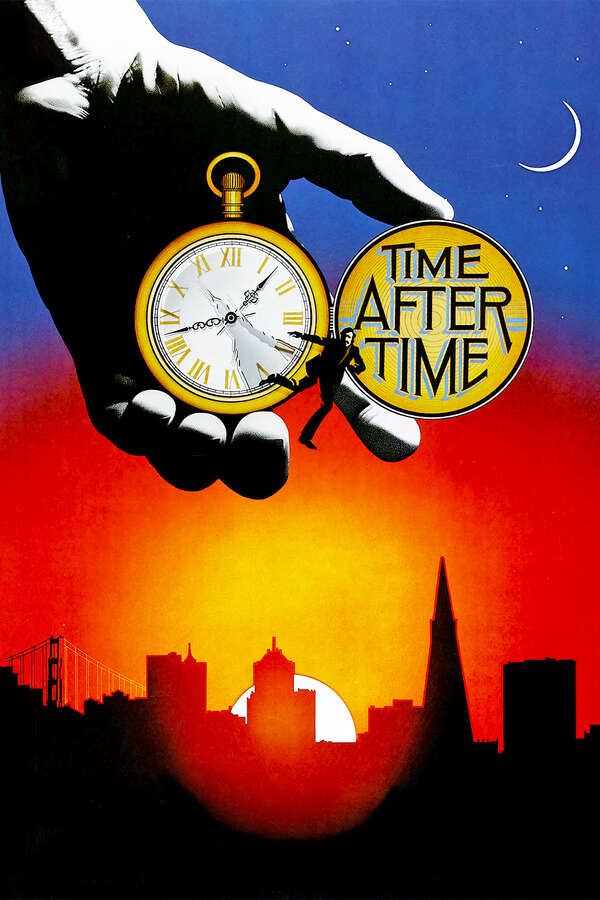 |
What if H.G. Wells hadn’t just written The Time Machine, but what if he had invented one too? What if he decided to show it off to his intellectual friends at a dinner party? What if one of those friends was secretly Jack the Ripper, and with the police on his tail, seized an opportunity and escaped in the time machine to the future? And what if H.G. Wells followed him there to capture him? This bizarre and inexplicable series of events is the premise of Time After Time, one of the strangest time travel movies but weirdly also one of the most charming. Written and directed by Nicholas Meyer, it is a gem of a film, a thrilling and entertaining fish-out-of-water story that has fun with both the notion of these Victorian figures adjusting to the pace of 1970s San Francisco and the satire of looking at that world through a new lens. Malcolm McDowell is unusually wholesome as Wells, with Mary Steenburgen as his endearing love interest and David Warner as the shrewd Machiavellian serial killer. It is a remarkably unique film with a nice sense of humour, a touch of adequate tonal severity, and a movie poster for the ages, much too overlooked. Perhaps Criterion could help with that.
Support me on Patreon: https://www.patreon.com/JordanBosch
Follow me on Bluesky: https://bsky.app/profile/jordanbosch.bsky.social
Letterboxd: https://letterboxd.com/jbosch
Twitter: https://twitter.com/Jordan_D_Bosch
Comments
Post a Comment