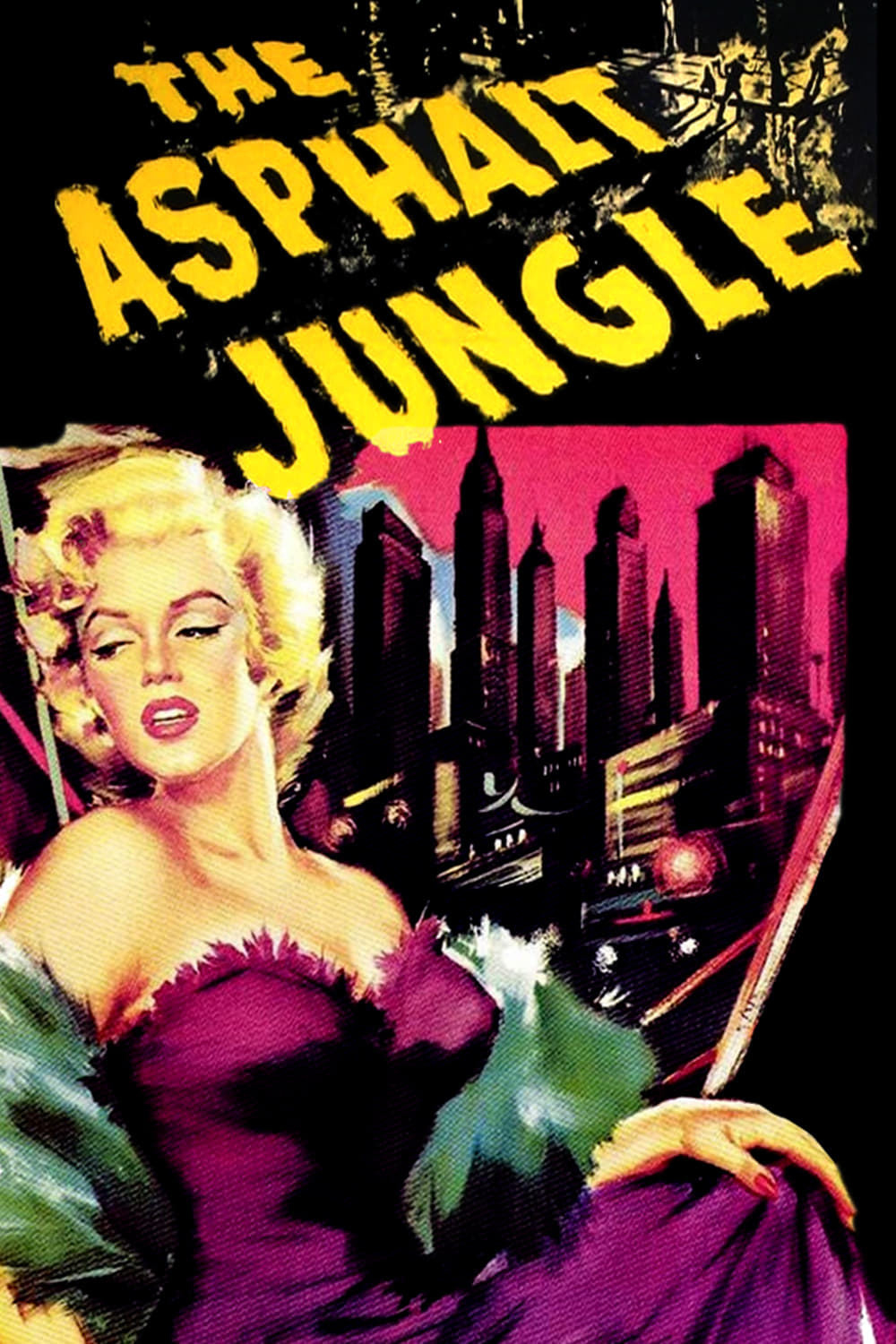
In The Asphalt Jungle, everybody is corrupt except for the criminals. They are at least honest about what they are and what they want, and have a nobility to them that the cops and seemingly upstanding figures in their orbit don’t. John Huston began his career with The Maltese Falcon, one of the essential film noirs -but it is not until this movie nearly a decade later that he carves out a more complex image of the cops and robbers dynamic that made film noir an interesting genre to contend with. These are not shifty, unsettling figures like Sidney Greenstreet or Edward G. Robinson. They are more nuanced and motivated and in their way more moral. They are the ones with families -or in the case of Sterling Hayden’s Dix, a committed girlfriend. While the indebted, incompetent lawyer weaseling in on their scheme ignores his ill wife for a creepy affair with a much younger woman.
It was a touch contentious in 1950. Louis B. Mayer, whose studio produced the picture, vehemently disliked it and it obviously raised a few Hayes Code concerns over its detailed depiction of a heist (and I imagine its cynical impression of authority figures rubbed some powerful people the wrong way as well). But it is about as pure a film noir as one can get. It feels like the inverse of Stanley Kubrick’s The Killing six years later -also starring Hayden- in which a heist is carried out by a skilled collection of criminals, only there they are depicted in a far less flattering light as to their personalities and methods. Huston wants to show them as smart and relatable, and that is the danger.
They are not particularly striking as criminal types, especially the mastermind Doc Reidenschneider (Sam Jaffe), a German freshly released from prison who immediately goes about plotting a major jewel robbery in some Midwestern city (likely Cincinnati). However his fixer -a prestige lawyer Alonzo Emmerich (Louis Calhern) is deep in debt -implicitly in part through his expensive affair with a much younger woman called Angela (Marilyn Monroe on the cusp of her stardom) and he sets about a plan to double-cross Doc for the fortune. Meanwhile Doc’s team for the heist consists of safecracker Louie Ciavelli (Anthony Caruso), getaway driver Gus Minissi (James Whitmore), and ‘hooligan’ Dix Handley -yes, really his name- played by Hayden, who seeks to use his profits from the heist to return to Kentucky with his girlfriend Doll (Jean Hagen) and buy back the horse farm his family lost in a depression.
Dix is no kind of hero -Huston does not totally justify his actions- but nor is he anywhere near the hideous personality that was Bogarts’ Dobbs in The Treasure of the Sierra Madre, another of Huston’s films to centre morally compromised characters. He is built into a tragic figure instead, with the subtle hint towards circumstances beyond his control having led him to where he is. It is the earliest I have ever seen Hayden in a movie, and even while he demonstrates a certain charisma that would explain his leading man status in this era before very different kinds of roles in Dr. Strangelove or The Godfather, there is a darkness in his eyes that Huston and later Kubrick really understood. But also an earnest soul is present, and it is nice to see the dignity of Dix’s relationship with Doll, who Hagen plays as neither ignorant nor dismayed -in fact she might almost be in on it herself (worth noting that for Hagen this was just one year out from her stellar comedic turn in Singin’ in the Rain, and a more different character you couldn’t find).
The rest of the cast on this movie is not exactly an assortment of major stars of the time. Huston in fact chose to cast largely New York stage actors for the film -it’s how Whitmore wound up in it, younger than I’ve ever seen him (he will always be Brooks to me). And there is an effect of some authenticity to this that makes the movie not feel like a polished Hollywood film. Bogart is a great actor but he would not have been right for Dix or any other part here. Jaffe however, is an excellent choice as the brains behind the operation -even earning an Oscar nomination for his cunning and crafty turn. Calhern also fits very well the slimy and craven Emmerich, duplicitous but incompetent. The writing for his character is just wonderful, the confident airs he puts on that mask a deep-seated nervousness especially as his machinations catch up with him. In some respects he feels like Jerry Lundegaard -the William H. Macy character from Fargo- only a better con man. And the detail of him having Angela call him “Uncle” is just a great bit of grossness I wouldn’t have expected from a movie in this time where it was atypical to call out an age-gap relationship such as theirs.
Relatively little of the overall screen-time is actually spent on the heist itself -its aftermath is much more in focus. Yet at the same time its contours and details are striking -one controversy that tailed the movie was the notion it was a lesson in how to pull off a robbery by showcasing how to deactivate an alarm and blow open a safe using nitroglycerine. It got into the roots of such a crime in a way that caper films usually didn’t. That style of detail in presentation did have quite an effect on the heist genre. Yet a French movie from a few years later that perhaps feels like its closest cousin, Rififi, is supposedly a coincidence as director Jules Dassin claims not to have seen it -a bold assertion given both movies have similar post-heist storylines.
And that is the bulk of The Asphalt Jungle -the fallout of the crime and the ways in which the various players are punished. It’s not like the crime itself went off without a hitch -the alarms of neighbouring buildings are triggered by the safe explosion and a physical confrontation does happen that results in a critically injured Ciavelli. Then the attempted double-cross by Emmerich goes south when his cop buddy Brannom (Brad Dexter) is quickly killed by Dix, and Emmerich hysterically folds immediately from his plan -yielding what control he had over to Dix and Doc. Indeed with Dix having struck the guard that brought about the mess in the actual robbery it would appear that Doc is the only competent party in the whole affair. Huston has a respect for this character he doesn’t show anyone else in the film, an admiration perhaps for his savvy and even in his one critical downfall later, there is something romantic in the nature of what moves him to fateful distraction.
As per Hollywood mandate, nobody gets off scot-free, but it is interesting to see how Huston illustrates one set of characters facing consequences to another. Doc and Dix are afforded a tragic dignity, Emmerich is not -his ending heavily coded as matching the nature of his character throughout: a timid, irresponsible man who thinks exclusively in short term gains and pleasures. Dix on the other hand thinks only in the long-term, and the restoration of his family legacy -by the end literally just out of reach for him. Their contrast is very intentional, even as they meet the same end. The robber is granted sympathy, the lawman is not.
I don't know that Huston was attempting anything radical with this -it certainly wasn't so unusual a trope in literature, he may have just found a way to adapt W.R. Burnett's book more accurately. But it is the movie's distinguishing character. As is the way he presents it with a tangible grit in the filmmaking. Huston doesn't cut as often as another filmmaker with such material might -the scenes feel more grounded and palpable, the tension is more immediate. Long after the heist itself, the momentum doesn't let up, you can sense its urgency. Outside of maybe some of the pictures from Poverty Row, this was the closest to ground-level crime that a Hollywood film had yet gotten.
The Asphalt Jungle is not a reversal of the accepted moral binaries of cops and robbers but it is a notably nuanced film in its depiction of both. And that is what makes it particularly interesting, alongside its skillful direction, performances, and hardy tone. Its image of the underworld is rightly authentic to its evocative title. It is a gritty asphalt jungle out there, where morality knows no character. And Huston is skeptical if anyone can make it through its dense wilderness.
Support me on Patreon: https://www.patreon.com/JordanBosch
Follow me on Bluesky: https://bsky.app/profile/jordanbosch.bsky.social
Letterboxd: https://letterboxd.com/jbosch
Twitter: https://twitter.com/Jordan_D_Bosch
Comments
Post a Comment