
Back in September, one of the great world cinema titans died at age ninety-one, and I’ve been meaning to put out something in recognition of that. Whatever you made of him or his movies, Jean-Luc Godard was undeniably one of the most important filmmakers. At the forefront of the French New Wave, arguably the most consequential movement in cinema history, nobody more defined ‘the radical artist’ than this French socialist obsessed with breaking down the rules of cinema, redefining its’ limitations before experimenting beyond those. He is one of only a few classic European filmmakers (another being Bergman) who is so ubiquitous as to be the source of shorthand. Anyone wishing to emulate for parody or otherwise the “pretentious art film”, they’ll usually look to Godard (and specifically Breathless) for influence.
But while he was certainly an auteur with defined tendencies and themes -some of which are indeed quite difficult and alienating for their intellectual obtuseness- his work was multi-faceted and more than just the stereotype. For instance, he once made a sci-fi film, and not in the sense of a movie with just marginal speculative elements about the cosmos or aliens or superpowers; but a full-on futuristic fable about supercomputers and dystopian society, with ample details of world-building. It was called Alphaville and it’s one of the most curious sci-fi movies I’ve ever seen.
This is a film explicitly set in some far-off future, in an Orwellian society of thought police and control, and yet it has none of the markers we would associate with the genre on either a narrative or technical level. There is not a single special effect or fake set used in this movie, no piece of technology that was not available to Godard in 1965. In fact it was just shot around Paris utilizing only what was already there to convey its’ image of a twisted world of tomorrow. It’s actually quite ingenious, in the ways that Godard both disguises and reveals 1960s Paris as a tangible apocalypse, a mirror of Fritz Lang’s Metropolis, ruled by automatons -the idea very much being that the dystopia he alludes to is here, or very well could be under certain political circumstances.
 |
He notably blends this setting and context, and in so doing tonally accounts for its’ twentieth century aspect, with the aesthetics and visual language of film noir. His lead character is even borrowed from a series of pulp crime movies, Lemmy Caution, as played by the American-born Eddie Constantine. Caution has recently come to Alphaville from “the Outlands” in the guise of a journalist searching for a missing fellow agent. His mission changes though, as finding this agent leads to him tracking down the mysterious creator of Alphaville, a Professor von Braun, and subsequently endeavouring to destroy the powerful computer Alpha 60 that controls everything and seems to be a constant presence in Caution’s ear. Along the way in this world where emotion is outlawed, he meets and can’t help falling in love with Natacha (Anna Karina), von Braun’s daughter -on her own journey to escape.
It sounds like a much more straightforward plot -hell, even Blade Runner-adjacent in its’ mystery noir overtones- than it is. Of course Godard infuses it with a lot of surreal visual and technical choices that emphasize its’ ideas more than any vestige of story or character. Images of scientific equations blare across the screen with recurrence, the voice of Alpha 60 (which I suspect is Godard himself -a very chilling computer voice) coming in to pontificate on the values it stands against. And characters discuss these heavy themes and existential implications even more so. What it boils down to is this vision of a future where both free expression is prohibited and all human virtues are censured for the efficiency of a mechanized, automated world. The fight against this regime takes the subtle form of the heroes uncovering their hidden capacity for these sensations that in of themselves are enough to soften Alpha 60’s power over the populace -very boilerplate science-fiction notions, quaint if taken at face value.
Godard seems pretty sincere though, especially where his allegories come into play. Some of their tenets are pretty blunt: the architect of this evil being named von Braun and having an earlier alias ‘Nosferatu’ is pretty pointed. And what we do see of the physical aspect of Alpha 60 is very much the big computing machines as they were known back then -with all the attached association of military-science. I would venture Godard had a dim view of the scientific community in the aftermath of the Manhattan Project -those calculations he displays every so often have an ominous tinge to them. As with any Godard film, there is social or artistic meaning beaked in everywhere, and that is what’s most important.
Alphaville dares to be a hopeful film though. Unlike other Godard films of this period like Breathless or Vivre sa vie, it doesn’t end depressingly, even if the demise of Alphaville is markedly ambiguous. It affirms those virtues that were forbidden, Natacha can freely and with relief say “I love you” to a man she has no chemistry with. Somehow, it is powerful. And that’s a way to sum up Godard if ever there was one.
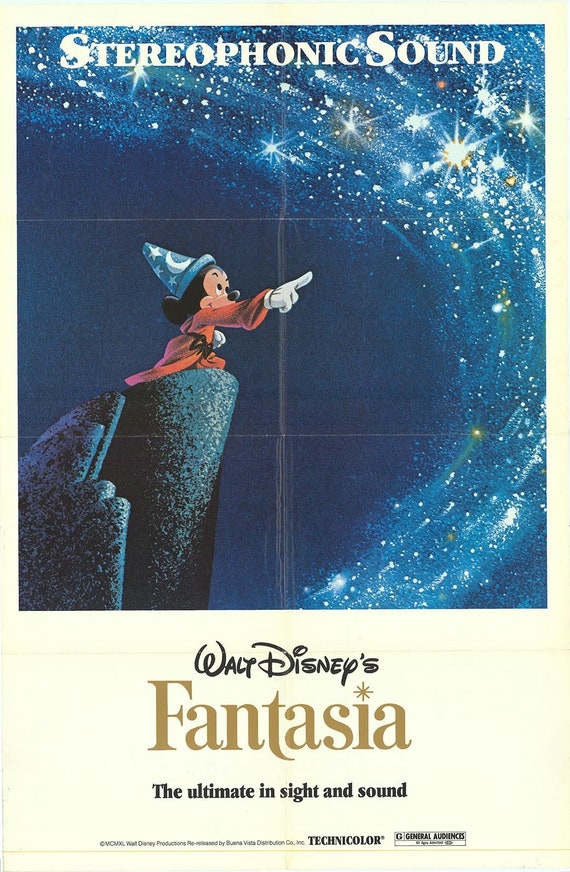 |
WALL-E just made history as the first Disney inductee into the Criterion collection, and much as I have issues with that company, I will acknowledge there are certainly movies produced there worthy of Criterion recognition. And probably chiefly so is Fantasia, the most experimental, “artsy” picture Walt Disney ever made. A collection of short subjects marrying stylized animation with classical music pieces, it is one of Disney’s most delightful and enduring early movies. And back when the company still valued intrepid artistry it is some of the most beautiful and imaginative animation you’ll ever see. “The Sorcerers’ Apprentice” featuring Mickey Mouse, is the popular standout, although each segment, with it’s own distinct character, is captivating and breathtaking in its’ own way –such as the closer “Night at Bald Mountain”, and my particular favourite “Rite of Spring”, which sets Igor Stravinsky’s lush yet epic ballet in the cosmic context of the dawn of life and the age of dinosaurs. It is one of the most unique animation projects Disney has dared to take on, and still one of their richest and most highly acclaimed features. If Criterion is setting its’ foot in this brave new territory, Fantasia should be early on their priority list.
Support me on Patreon: https://www.patreon.com/JordanBosch
Follow me on Twitter: https://twitter.com/Jordan_D_Bosch
Letterboxd: https://letterboxd.com/jbosch/
Comments
Post a Comment