
This is primarily a movie blog. It didn’t start out that way, as though I intended to talk a lot about movies from the start, I also wanted to use it as a forum for my satirical interests and commentary. Hence catalogues like ‘Pop Culture Shock’ and the abandoned ‘Political Incorrectness’, a heading name I increasingly regret. But as I watched more and more movies and grew as a critic I streamlined towards a more exclusively film-based focus. I say all this, because for the month of September, which I’ve annually made a theme month, I’m going to be breaking from that focus to talk about another form of art I have an incredible enthusiasm for: comic strips.
My love of comic strips pre-dates my love of film. Maybe it’s the creativity, the humour, the design, or the fact that all three can be integrated seamlessly in a short series of panels; but I’ve always had a fascination with them ever since I fell in love with the imaginative adventures of a mischievous six year old boy and his tiger. And I still keep up with them, there are a bunch of strips I read regularly and numerous others I’m familiar with.
But outside of really big names like Peanuts and Garfield, few are well-known to the public, especially of the more recent crop that have only been around for a decade or two. Ask someone to name a comic strip since the year 2000 and they might be able to say Pearls Before Swine. Because many strips from the 30s to 70s are still in syndication today, it’s harder for new strips to gain a footing and compete against giants like Garfield, Blondie, Beetle Bailey, Hi and Lois, Dennis the Menace, Hagar the Horrible, B.C., Family Circus, Frank and Ernest, Andy Capp, The Lockhorns, and Snuffy Smith, many of which have lost their original creators and haven’t been funny in decades. But there are still great new strips out there, finding their niche, evolving the form, and becoming some of the most inventive, funny, and engaging cartoons the medium has known.
So I want to highlight some of them -four of my favourite strips of the twenty-first century. If you want to read them, as you should, two can be found in their entireties on GoComics.com and the other two on Comics Kingdom. Hopefully it’ll both promote these particular series and raise awareness to the quality of modern comics. After all, there are plenty of other great young strips out there worth seeking out.
This is Comic Strip Month!
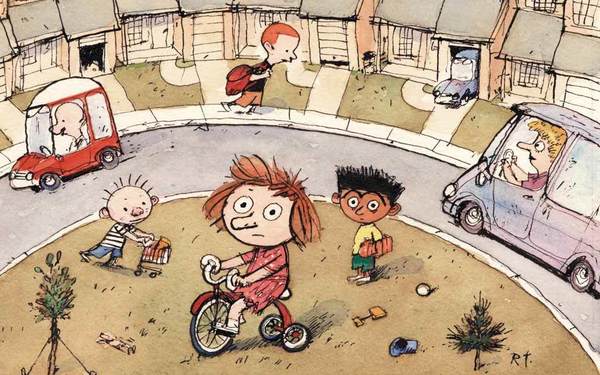
Richard Thompson was an established cartoonist for almost two decades before he started Cul de Sac in 2004. A D.C. area cartoonist, he was best known for his comic illustrations in the Washington Post, specifically his unique cartoon series Richard’s Poor Almanac which ran from 1997. Given how sharp his social, pop cultural, and political satire was in this, it’s surprising how apolitical, unassuming, and humble Cul de Sac was; for aside from taking place in the suburbia around Washington, it had no interest in the world beyond Alice and Petey Otterloop’s perspective of it.
Cul de Sac began its run as a weekly Sunday comic where it stayed exclusively for three and a half years. It’s daily syndication began in September 2007, but by then it was already apparent this strip was the long-awaited heir to Peanuts and Calvin and Hobbes.

The strip is about Alice Otterloop, a rambunctious, uninhibited four year old girl and her neurotic, hypochondriac older brother Petey, and their lives in suburbia. The strip follows their family life with their parents Madeline and Peter, Alice’s experiences at Blisshaven Preschool and her relationships with several friends including Beni, Dill, Nara, Marcus, and “Bucket Head” Kevin, and Petey’s struggle with his anxieties and introverted personality.
As with most great strips, Cul de Sac has its cycle of recurring gags and motifs, such as Petey’s picky eating record and shoebox dioramas, his love of hilariously tedious ‘Little Neuro’ comics, Dill’s unseen older brothers and their trebuchets, Miss Bliss and her unending engagement to banjo player Timmy Fretwork, Peter’s tiny car, Mr. Danders the talking class guinea pig, Petey’s out of body experiences, the inexplicable jungle gym, the Uh-Oh Baby, and of course Alice’s manhole cover dancing. It takes place in a cozy but well-defined world, with a simple but wildly colourful cast of characters, and a sense of humour that’s really clever, often drawing from the idiosyncrasies of childhood.

It’s drawn in a style that looks almost crudely simple and easy, the kind of sketches you might find doodled on any notepad, but is actually more sophisticated and complex than meets the eye. The charm of its appearance is in how natural it looks, how pure, much like the cartoons of George Herriman and Charles Schulz. And particularly like the latter it’s got a timeless sensibility, which is reflected in the strips’ subjects and jokes.

Cul de Sac isn’t quite as divorced from time period as Calvin and Hobbes or even Garfield, but it does rely much less on technological, cultural, or political markers than most other strips. None of the kids for example have their own mobile devices, video games are virtually non-existent, and even the computer Petey occasionally uses is much more akin to the ones I knew at his age than what kids of 2007 would be used to. And perhaps because Thompson was regularly topical in Richard’s Poor Almanac, it was something of a relief for him to avoid such things for his more important comic.
 What makes Cul de Sac so great is firstly its characters. Alice is one of the funniest, consistently erratic, frequently self-absorbed, and most strangely endearing characters in any medium. Her curiosity is really her greatest attribute, she’s constantly discovering things, learning concepts for the first time, and along with her classmates, is constantly perplexed by adult behaviour. Her enthusiasm and indignation alike are unbridled, and her incredibly genuine four year old behaviour is amplified by the art of the cartoon. For as realistic as this strip is in its understanding of childhood, it doesn’t forget it’s still a cartoon, and Thompson really takes advantage of that. He is a master at expressions, giving Alice wonderfully exaggerated frowns and fits of rage as well as moments of delight and exuberance. Just the way he draws her mouth can make all the difference.

Petey is one of the great original characters of the comics page too –there has never been a kid quite like him, so timid and fearful of everything, an obsessive compulsive with an imagination, albeit one informed by his bland tastes. His unique perception is perhaps his funniest character trait; how he responds to unusual things around him, being convinced, for example, his classmate Ernesto (a snobbish kid with an eagerness for adulthood) is not actually real.
 All of Alice’s friends are likeable in their own way; Dill is the one who stands out most, as eccentric as he is innocent, and always with a hilarious nonsensical statement to spout. The parents have their own personalities, being neither overly authoritative nor one-dimensionally ignorant, acting very much like real people with genuine joys and hang-ups. Even the tertiary characters are really interesting, like the Otterloops’ senile grandma throwing devils eggs at cars, and her monstrous dog Shirley, or Petey’s nerdy crush Viola D’Amore.
 All of Alice’s friends are likeable in their own way; Dill is the one who stands out most, as eccentric as he is innocent, and always with a hilarious nonsensical statement to spout. The parents have their own personalities, being neither overly authoritative nor one-dimensionally ignorant, acting very much like real people with genuine joys and hang-ups. Even the tertiary characters are really interesting, like the Otterloops’ senile grandma throwing devils eggs at cars, and her monstrous dog Shirley, or Petey’s nerdy crush Viola D’Amore.
 Great humour is another thing Cul de Sac has in spades. It was certainly an asset that Thompson came to the strip with all his Washington Post experience giving him a sharp degree of wit. A lot of the humour comes out of the characters’ personalities, and they’re strongly defined enough that often they seem to write themselves. The jokes can be inventive, observational, nostalgic, cutting, even hilariously sweet or downright surreal. Thompson occasionally likes to exaggerate trivial kids’ problems and observations to really creative degrees, making for some really memorable and wholly unique gags. And all of this is done so effortlessly and with such grace.
Of all the comics I’m talking about this month, this is the only one that isn’t still in production. Cul de Sac ended its run on September 23rd, 2012, but it wasn’t by choice. In 2009 Richard Thompson was diagnosed with Parkinson’s Disease, and by 2012 the symptoms had worsened to the point he could no longer draw the strip. It wasn’t an easy thing to have to give up. He even had plans for storylines into 2013, such as sending the kids to summer camp, and he’d started introducing new characters in the last couple years, like Sofie, a new girl at Blisshaven, and Andre and Loris, kids Petey befriended at a comic book workshop. And there was some hope that if he could beat the disease he could return to the strip. But sadly, Richard Thompson passed away on July 27th 2016.
In a business where a successful cartoon is a job for life, where a lot of comic strips have run long past their expiry dates, it’s rare for one to end too soon. But the love for Cul de Sac is still felt amongst cartoonists. For a month in 2012 while Thompson was undergoing treatment, the strip was drawn by a series of guest artists including Michael Jantze, Lincoln Pierce, Stephan Pastis, and Mo Willems. Bill Watterson was a fan, having peaked out of obscurity to write the foreword for the first book collection, and painted a likeness of Petey for the Team Cul de Sac Parkinson’s fundraising initiative in 2011 -his first public work of art since ending Calvin and Hobbes in 1995. Art Spiegelman, creator of Maus, in his introduction to The Complete Cul de Sac, called it “The Last Great Newspaper Strip”. “His achievement as a cartoonist is a towering one,” Spiegelman said. “And it will loom even larger when the final line is drawn under the history of the comic strip form.”

Spiegelman and others have noted that had Cul de Sac appeared a couple decades earlier it would have caught a lot more attention and may even have had a relative cultural impact. But by the mid-2000s the comic strip was already steadily becoming less popular in an age of advanced media, and it was nigh impossible for one to take off or be noticed by the general public. Nonetheless, Cul de Sac remains a comic strip masterpiece, certainly the most recent strip to which that approbative can be applied. The comics’ page is a poorer place for Richard Thompson’s absence, and though it’s a joy to revisit Cul de Sac, it’s a small tragedy too.
For more information on Team Cul de Sac and what they do, you can check them out here: http://teamculdesac.blogspot.com/. To donate to them via the Michael J. Fox Foundation, click here: https://fundraise.michaeljfox.org/tf-2018/tcds.

Follow me on Twitter: https://twitter.com/Jordan_D_Bosch
Letterboxd: https://letterboxd.com/jbosch/
Comments
Post a Comment