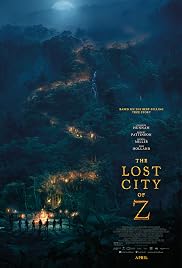
Telling the real-life story of explorer Percy Fawcett (Charlie Hunnam), the film follows him, starting from his days as a soldier training in Ireland in 1905. In 1906, he’s recruited by the Royal Geographical Society to lead a survey expedition along the Brazil-Bolivian border. While in South America he becomes enamoured with the environment and especially the clues to a rich native history ignored by the western world; more specifically, signs of an ancient hidden city somewhere in the Amazonian jungle. His desire to discover it drives him through the decades of the early twentieth century.
Though this film has plot and geographic similarities to Aguirre, its presentation is more reminiscent of an old Hollywood epic, particularly a David Lean epic, and as a massive fan of David Lean, I really approve. There’s a Lawrence of Arabia type of arc that Fawcett goes through in his relationship to this part of the world and its people over a long period, and coupled with the scope of the film and its wonderful cinematography and editing, you can’t help but be reminded of that 1962 masterpiece.
But this movie is also different enough. Firstly, it’s an epic that’s accessible to a modern audience, but treats them maturely and intelligently nonetheless. Also, it’s about an hour shorter than most old Hollywood epics. Though the movie portrays the public excitement for exploration, It also shows the harsh realities of men being separated from their families for long campaigns taking up years. Fawcett’s relationship with his wife and children is strained, and we see the impact this has on them, especially on the children growing up. There’s also a roughness to his journeys and troubles on the Amazon, with suspense and an action-violent edge that you wouldn’t find in other epics, but it contributes to the audience’s investment. Not to mention these scenes are very fun to watch.
Charlie Hunnam is really good as Fawcett conveying his passion and enthusiasm for South America wonderfully. Of course it helps that Fawcett is an interesting character to work with. His attraction to the idea of the City of Z is gradual, and is motivated out of a mix of wanderlust, validation due to his family reputation, and pure exploratory zeal to learn and possibly bring more dignity to the perceptions of South American natives. His military background provides him with necessary leadership skills, and that part of his character is present in his every action. The supporting cast is headed up by Robert Pattinson as Fawcett’s right-hand man Henry Costin, who once again proves that Twilight was just a fluke, and he’s actually quite a good actor. He’s sort of the comic relief, but also a really likeable character in his own right. Sienna Miller plays Fawcett’s wife Nina, loyal but sometimes frustrated with Percy’s long voyages and eagerness to endanger himself. Her response to a plot point in the last act may be one of the films’ few under-developments. The cast also includes Ian McDiarmid as RGS chair Sir George Goldie who sets the plot in motion with his assignment for Fawcett, Edward Ashley as Corporal Manley who accompanies Fawcett and Costin on their voyages, Angus Macfadyen as Shackleton expedition veteran James Murray, Franco Nero as a plantation owner, Harry Potter’s Harry Melling as an outspoken member of the RGS, and Tom Holland as Percy’s son Jack. All of them, particularly McDiarmid and Macfadyen, are great.
Very much like James Gray’s last film The Immigrant, which arguably didn’t get the attention it deserved, The Lost City of Z puts a lot of effort into historical authenticity. Nothing feels out of place and it better immerses you in the period. I love the scene of Fawcett addressing the RGS fervently on his finds, and their rowdy response; his fortitude, confidence in his theory and their objections feel very real. The film depicts the First World War at one point and though it’s not very long, it captures the grimness and atmosphere of death very well. And again, the cinematography is terrific (the use of contrast lighting in the final scenes especially look beautiful) -you get the sense James Gray really cares about his mise en scene, which isn’t always necessary for a director depending on the type of film, but gives this movie even more to go on. As if it didn’t have enough already.
The Lost City of Z makes me crave more explorer biopics, and more epics of this nature. It’s a finely crafted, visually amazing, well-performed story of a very interesting figure and the ambition that dominated his life. Though it’s not quite as good as Aguirre or the greats of David Lean, it is pretty brilliant, and I’m glad it was made now with such finesse.
Comments
Post a Comment