After her terrific performance in Star Wars: The Force Awakens, it was expected that Daisy Ridley would start showing up in other films. But many people may not be aware that she just has, though in one that’s only getting a limited release and was in fact actually released twenty-five years ago.
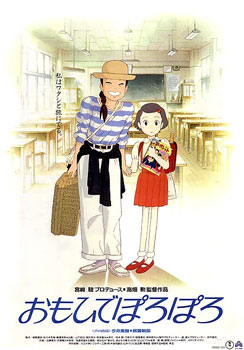
Only Yesterday originally released in 1991, is an animated film from Studio Ghibli made by the great Isao Takahata -the filmmaker behind the powerful Grave of the Fireflies and the more recently captivating The Tale of the Princess Kaguya. Until now it’s never been dubbed in English as every other Studio Ghibli film has. Thanks to GKIDS however it’s finally come to North America with an English dub starring Daisy Ridley and Dev Patel and is certainly a long time coming. With how long it’s taken, you might fear it’s because of poor reception or that this was the film Studio Ghibli didn’t want re-released around the world. On the contrary, I think this is one of their very best films and by the standards of Studio Ghibli, that’s saying a lot!
The film is about Taeko Okajima a 27 year old woman who is fed up with the city, having lived her entire life in Tokyo, and decides to visit the distant family of her brother-in-law in the countryside. When she arrives she becomes a hard worker in the safflower harvest and begins to enjoy this very different kind of life, particularly in the company of Toshio a country-bred labourer. All the while, she reflects on her childhood in the 1960s the trials she had to go through especially in school that helped discipline herself and make her the woman she’s become today.
One of the most notable things about this film is that this was the first Studio Ghibli release to be a snippet of real modern life with no magical or fantastical elements involved. Since then we’ve had Whisper of the Heart and From Up on Poppy Hill, both good in their own right and similarly coming-of-age stories, but this film has the more interesting factor of being told from an adult’s point of view. It’s an animated adult drama and arguably more than any other Ghibli film, doesn’t need to be animated. And while I prefer animation to be conveying something that can’t be conveyed through live-action (one of the reasons I didn’t like last year’s Anomalisa), this film really seems to earn it. Though not quite as beautiful to look at as some of Takahata’s other films, there are some great visuals. The golden safflowers look wonderful and everything in the country just feels full of life which is a great contrast to the artificiality of the city as well as Taeko’s flashbacks. And while those flashbacks have a paleness to them, a focus on white and cloudiness, I love how perfect an allusion it is stylistically to the opaqueness of memory. It’s in these scenes I know live-action could not capture this story nearly as well.
This is a film that’s well-structured and immediately relatable.Throughout, we’re following two stories in two times but both deeply connected. I’ve seen this device used in biopics a few times, but Taeko is nobody famous despite her childhood hopes. This is just a story about an ordinary woman reflecting on her past and coming to realize how it’s shaped her, who she is, and where she belongs. Pfft, sounds boring. What’s so great about that? Why would that work?
Well, because it’s just that; this is a film inherently about life, the connectivity between childhood and adulthood, how we’re shaped by our triumphs and mistakes, coming to terms with memories, and questioning our history, our choices in relation to who we are now. These are things everyone can relate to. I think Only Yesterday is very comparable to one of my favourite films, Boyhood which dealt with a lot of the same themes.But here we are given a glimpse of adolescence from a girl’s perspective in Japan where there are cultural as well as circumstantial distinctions. The focus is appropriately placed in the flashbacks on generally minor things, but things that were very important to her, such as her obsession over owning a popular product, or over-hyping a performance in a school play. We see her reaction to having her first period, the scene which kept Disney from releasing the film for so many years (so let me get this straight Disney; shape-shifting testicles in Pom Poko is fine, but a girl realistically freaking out over her first menstruation is too much??). How all of these connect to her current situation whether through conversation or just a nostalgic experience brought on by a sight or sound is very fascinating. It emphasizes more the importance of all the objectively small things in our lives because of how big they could be at the time to each person and thus more etched into memory. While Boyhood focused on minor things, it also incorporated a lot of big changes in life, but this film didn’t need them. Because what was important were the big moments to Taeko, so we didn’t need to see her family move, her first date, car, or drink. In doing this it emphasizes what not a lot of similar films have, that life changing moments are not all the same but very personal in nature.
Because she represents this very well, Taeko is a superb and interesting character, being just the right amount of identifiable and unique to make the points of this film clear. She’s completely believable in her enthusiasm for a different kind of work and lifestyle and you can almost physically see her transform by her experiences in the country aided by the fact that voiceover gives us a window into her thoughts. As she finds out who she is, the viewer is also compelled to contemplate the same ideas. Like Taeko, I found myself reflecting briefly during and after the film. Especially so in my favourite scene towards the end which in place of a great climax only consists of Taeko and Toshio talking while driving in the rain; a story being told without using a flashback for a change which actually makes it more affecting. It’s poetic, beautiful, moving, and even insightful (Toshio not for the first time offers an alternative idea to a point of view). And it’s bound to keep you thinking not out of frustration or speculation, but reflection. It encourages you to look inward and to apply the film’s character journey to yourself. To elicit this kind of response is a great thing for a movie to do and one of the main purposes of the art of cinema.
If I have criticisms they would be fairly minor. Like it might have been nice to see different stages in Taeko’s childhood rather than to only be focused on the time she was ten. I’d have liked to have seen how some of these important moments affected her later adolescence. But at the same time I understand that to many there really was just that one year in their childhoods that seemed more important than the rest. So it’s a criticism I can easily overlook.
Suffice it to say, it’s a very good thing that Only Yesterday has finally been released in North America and I can’t wait to see this dub. I truly think it’s one of the finest Studio Ghibli has ever put out and as many people as possible deserve to see it. Even when Ghibli is not making grand and magical flights of fantasy or epics, they still have a profound ability to hit home in their subtlety, style, and keenness to in some way touch the human spirit. And I think Only Yesterday may be the best example of that.
Comments
Post a Comment