Douglas Fairbanks’ 1924 star vehicle The Thief of Bagdad is an interesting, technically impressive, if sometimes underwhelming silent era swashbuckler. Fairbanks is charismatic in lieu of his obvious miscasting for the role, yet there is really only one other performance that stands out and gives the film some much needed colour. And that is a young Anna May Wong at the start of her career playing the fiendish slave girl to the princess who needs saving. She is striking for what the role demands of her, emanating beyond its blunt archetype.
Unfortunately, this would be the pattern for Wong for much of the next decade and a half -a scene-stealer captivating audiences but kept at a distance due to the pervasive racism of the Hollywood industry at that time. Wong became a star, as much a household name as many of her white colleagues, but she was never allowed to be THE star as a Chinese-American woman. The system actively blockaded it. Leading parts weren’t being written for Asian women, and besides in that time she would require a leading man, and anti-miscegenation rules made that a non-starter.
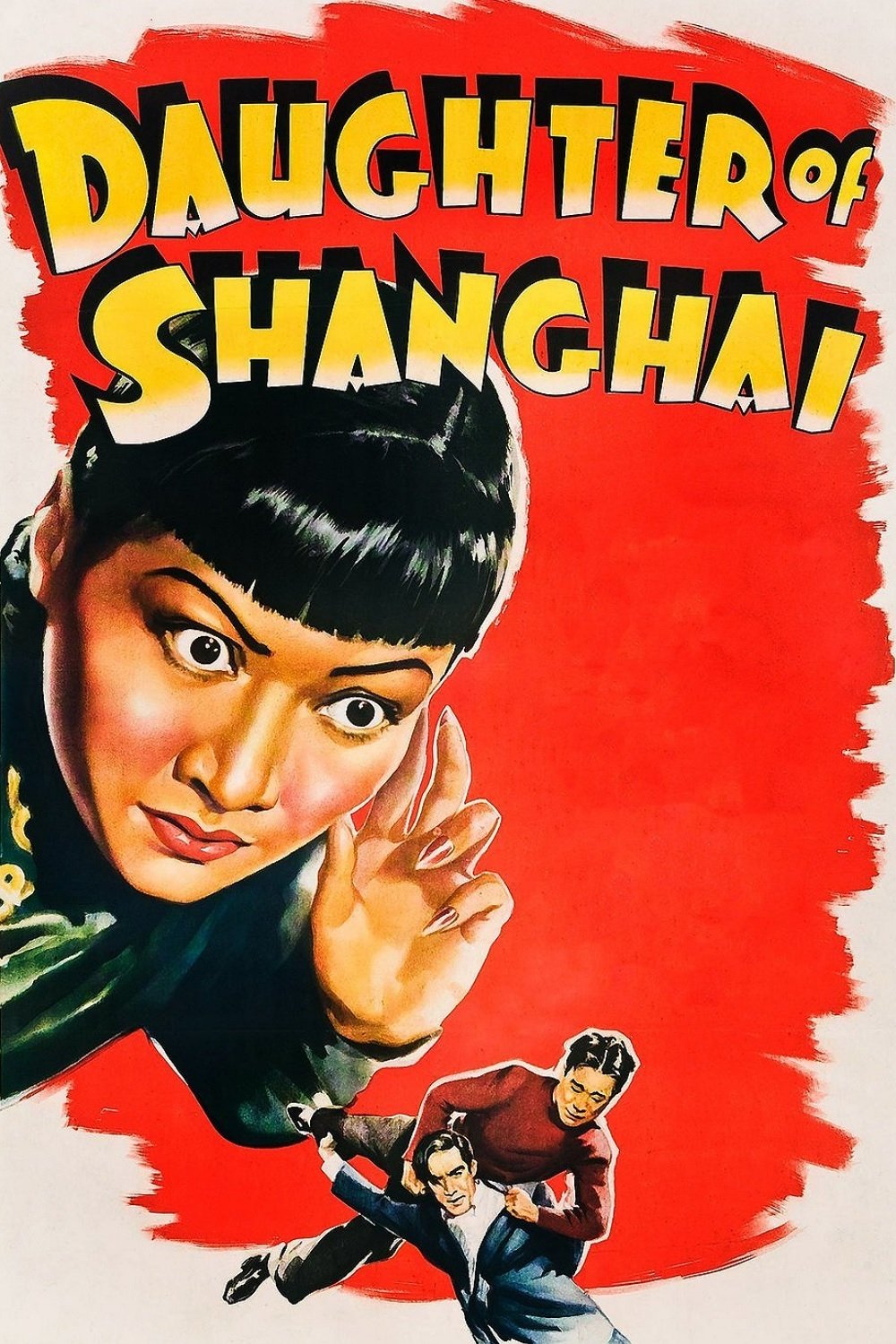
But Wong remains a figure of immense fascination for her time and status. She was a legitimate groundbreaker in her limited spaces, normalizing Asian-American identity for white audiences and always fighting fiercely for better work and agency. Like Josephine Baker before her, she went away to Europe for a portion of the 1930s where there were more opportunities for her, but eventually she found some back home often in the “Poverty Row” system of independent B-movies (where a lot of black film was concentrated at the time). And yet Daughter of Shanghai was a Paramount feature. Perhaps the allure of Wong coming back stateside prompted them to give it more leeway. It certainly brushes up against the conventions of this time, including not just one but two Asian lead characters; and it is of course a better movie for it. A glimpse at what Hollywood really should have been in this era.
It is a short movie, too short really at just over an hour, and it is the pacing and editing that are the movie’s greatest weaknesses -as we’ll get to. It’s story though concerns the actions of a gang of smugglers who illegally bring foreign nationals from China into the U.S via cargo planes. But they are careless and if threatened with capture have no qualms about abandoning their cargo, dropping a load of human beings into the ocean. In California they attempt to extort a successful Chinese business owner Mr. Lang (John Patterson) into employing the immigrants (exclusively referred to as “aliens”), but Lang refuses to risk his business and when he tries to turn the gang into U.S. Immigration is lured into a trap and killed. His daughter Lan Ying Lin (Wong) survives however and determines to find and expose the gang leaders. As does a sharp government agent Kim Lee (Philip Ahn).
For as much as the movie is a great step forward in terms of its representation, that does come at the cost, as you can see, of xenophobic attitudes around immigrants and the ills of circumventing the supposed legal American immigration system. Another, more socially oriented movie, might frame a gang engaged in this activity in a positive light -bringing those people who fall outside the arbitrary proper channels to their desired ‘land of opportunity’ anyways. Here though it is clear that even with certain freedoms allotted to the movie it has to abide by a set of messaging rules. However where a conservative movie might be inclined to demonize the immigrants themselves for the attempt of their passage, this movie only portrays the criminal white gang exploiting them as the villains. And it is interesting given the very early reveal that Lan Ying Lin’s trusted confidante Mrs. Hunt (Cecil Cunningham) is actually the ringleader of the organization makes this a movie in which virtually none of the white characters are heroes, from Charles Bickford’s drunken, corrupt businessman in Central America to the pilots played by Buster Crabbe and a young Anthony Quinn.
By contrast, Wong herself gets to be the globetrotting hero seeking answers for the death of her father and the criminal enterprise exploiting her community. It is a showcase like Wong so rarely got, especially in the States, and she plays the part with conviction and confidence, while utilizing that same mystique that made her famous. There is a little bit of exoticism at play, especially where she goes undercover as a dancer in the club that Bickford’s Hartman runs -but she brings her own agency to it and it is enthralling to see her so starkly in control. The movie was fashioned around her and her degree of creative and star influence is certainly apparent. But so too is Philip Ahn's -billed insultingly low in the credits for what is arguably the co-lead role of the movie. Ahn exudes a sharp competence as well as any other leading man of the era, trusted and resourceful in his work. It is worth noting that at this time there were no actual Asian-Americans in the FBI -Lee is thus a groundbreaking character as he works with steadfast professionalism for the U.S. government. Ahn gets to do here in a small capacity some James Bond shit decades before James Bond ever hit the screen himself. And he and Lan Ying Lin make for a good partnership. The romance they are given at the end of the film when Lee asks her to marry him comes out of nowhere, perhaps a tacked-on romantic happy ending for Wong purely because she so rarely got them. It's a shame it is entirely undeveloped though, it would have been nice to see their chemistry.
It's one of a few missed opportunities due to the movie's fast pacing. It is just over an hour in length and yet the material is enough that could easily fill two. Director Robert Florey tended to keep his movies short, his other notable credits including The Murders in the Rue Morgue with Bela Lugosi and the very first Marx Brothers' feature The Cocoanuts. Sometimes the brevity suited the subject, but not on this film aiming to be a globetrotting mystery-adventure starring actors demanding unique characterization. The swiftness of the movie’s plotting gives the impression of missing scenes, significant details not elaborated on. That is especially true of those scenes between Lan Ying Lin and Lee. While the movie’s racially progressive attributes are nice, the hasty way they are sometimes presented -it’s as though the film is trying to sneak them by in the hopes that no one will notice. But again, it needn’t be. The movie neither breaks nor bends any rules of the Hays Code -the miscegenation issue that hurt Wong’s star exposure in other movies was not applicable here. Yet the two leads are even in their one scene of explicit romantic text entirely chaste.
Florey’s breeziness restrains the atmosphere and neuters some of the personality the movie might have. But it does find some room to break through. I particularly liked the couple comic beats between Lee and an old sea captain played by Fred Kohler where Ahn gets to demonstrate a little bit of deadpan comedy. It’s there also in his rapport with Lan Ying Lin, who likewise shows off some great moments of competence, such as in her deduction of Mrs. Hunt as the mastermind -a bit poorly played out though it may have been. It’s not just that the novelty of seeing Asian-Americans in this light is cool (and it is one of the few Hollywood movies Wong got to do in which she didn’t have to put on an accent), but that these people in particular are cool. And I have to imagine some audiences in that time thinking about that and perhaps questioning the nature of an entertainment system that otherwise excludes the likes of Wong and Ahn.
The year that Daughter of Shanghai came out, 1937, was also the year that a film called The Good Earth was released. It was an adaptation of the Nobel Prize-winning novel by Pearl S. Buck that centred on the struggle of a Chinese farming family. Rather famously, Wong campaigned hard to play the lead part -a rare opportunity to showcase her acting calibre in a role and much-anticipated movie perfectly suited to her. But partly because MGM was dead-set on Paul Muni playing the male lead character and anti-miscegenation rules applying even to characters in yellowface, Wong was locked out of the role and when offered the chance to play the villain was understandably offended and stood on her principles. The role went to the white Luise Rainer, the temporary Hollywood “it girl” of the late 1930s, who won her second consecutive Oscar for it. Daughter of Shanghai, which released eleven months after The Good Earth, feels like a response to that injustice, allowing Wong a leading, sympathetic role that she had been denied. Maybe a consolation prize and certainly not one that could compete with the big movies for scale or subject, but one that is an important historical touchstone in its way regardless. Anna May Wong deserved better by Hollywood. Daughter of Shanghai gives an idea of what that could have looked like.
Support me on Patreon: https://www.patreon.com/JordanBosch
Follow me on Bluesky: https://bsky.app/profile/jordanbosch.bsky.social
Letterboxd: https://letterboxd.com/jbosch
Twitter: https://twitter.com/Jordan_D_Bosch
Comments
Post a Comment