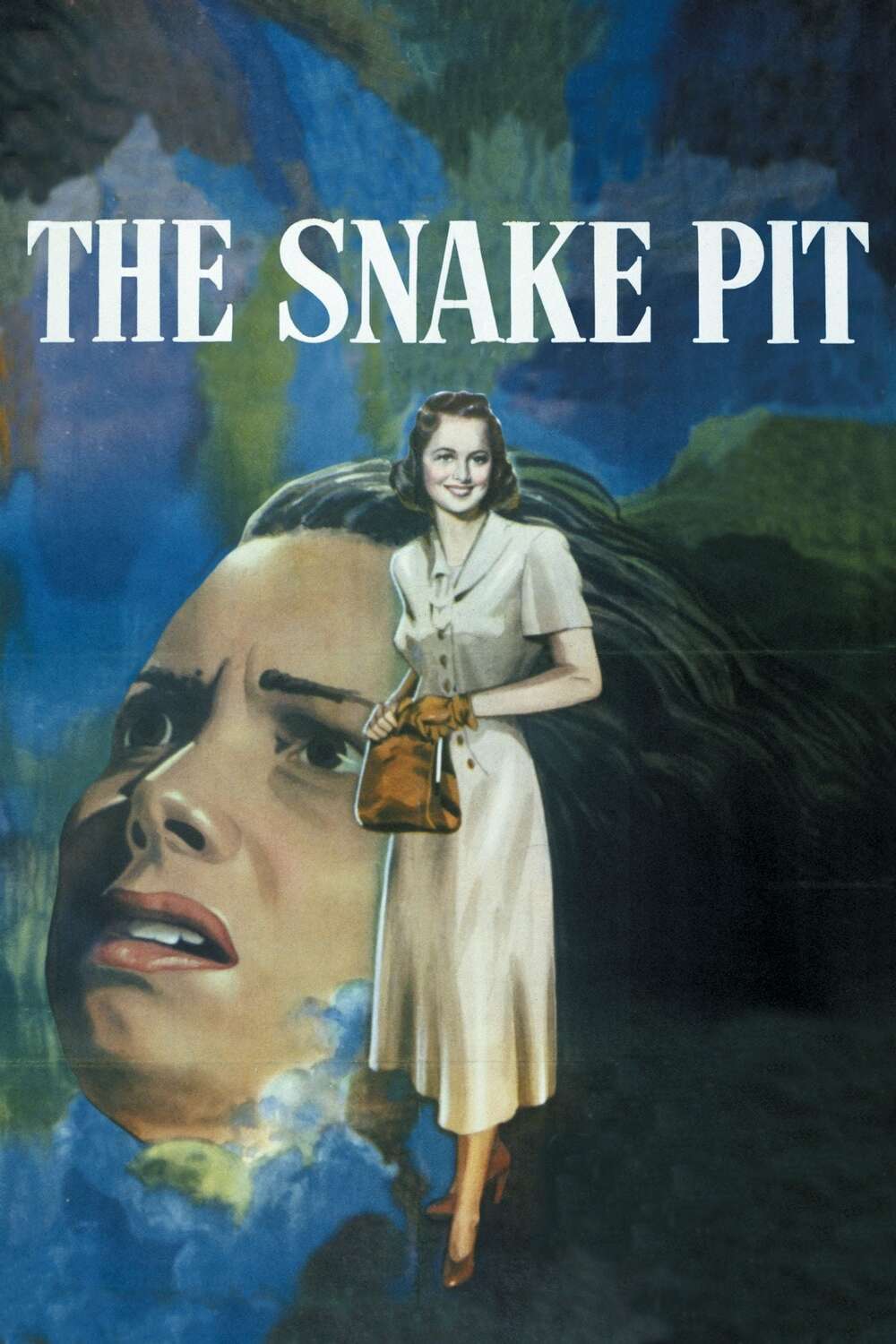
A movie about mental illness made in the 1940s is bound to not hold up to modern psychological scrutiny. Hell, even psychological scrutiny within a decade or so of its release. To watch The Snake Pit is to get a glimpse into how mental illness was perceived and treated in a time when it was barely understood and entirely stigmatized. Often, contemporary films that would depict conditions we might now identify as schizophrenia or psychosis would cast them as markers of someone to be either feared or pitied. Rarely was the subject addressed head-on and taken seriously. It was considered uncouth to do so. But by 1948, in the aftermath of the war and new concepts arising around PTSD and other traumas, perhaps Hollywood was ready to actually go there -or rather director Anatole Litvak was, who’d personally bought the rights to the novel of the same name by Mary Jane Ward and worked to make a film that would be empathetic towards people -though women especially- interred in asylums for the mentally ill, and exposing some of the inhumane harshness they face within that environment. The movie may get a lot wrong or feel quaint in its diagnoses of Virginia Cunningham, but it does mean something that she was given credence in a major motion picture.
She is a character apparently loosely based on Ward herself and is played in the film by Olivia de Havilland. Curiously we actually meet her in the midst of her treatment, the film opening up on Virginia already in an asylum side-eyeing other women in a little park outside the institution as they walk by her, unclear of exactly where she is and hearing a pronounced voice in her head apparently feeding into delusion. As she interacts with her patient Doctor “Kik” (Leo Genn) and the man who identifies himself as her husband Robert (Mark Stevens), whom she goes back and forth in remembering, her story is gradually brought to light -through Robert’s testimony and the doctor’s therapy sessions. Though at the same time, she is a victim of the system, moved through various wards of the institute -including at one point the dreaded “Snake Pit” where mentally ill women are simply left in an enclosed space to their own devices, like a collection of show freaks.
The movie vacillates between intended positive and negative depictions of the mental healthcare industry in the 1940s. Though being as it is in the 1940s, some of the positive effects can’t help but ring a different way with hindsight. The methods of treatments are undoubtedly primitive, and Doctor Kik is at the very least not questioned or judged much over prescribing things such as electroshock therapy early into the movie. His particular interest in Virginia, the impetus for an envious nurse’s machinations against the poor woman, are nonetheless somewhat inappropriate. And his psychoanalysis is very elementary and seems outcome-driven in a way that even the uneducated can pick up on. In exploring her past and what potential traumas fostered Virginia’s illness, there’s a lot of Freudian themes applied -like how she married her first husband because he reminded her of her father who had died young. The analysis probes further to even trying to explain her interest in writing and hesitance around remarriage, which stinks of misogyny by attributing even mildly her personality outside the heteronormative gender roles of the era as an aberration that could only be explained by connecting them to her condition. Doctor Kik is very paternalistic, and subtly patriarchal in other ways -condescending even- for as much as he may be genuine in his desire to help Virginia.
But while the movie may not be conscious of these issues around rudimentary psychoanalysis -which on its fundamentals it takes as scientific fact- it certainly is aware of the problems within the system of mental healthcare as far as the actual practical treatment of patients is concerned. Virginia is put through a lot, and unlike other characters of this variety in this time, she is has the audience’s full sympathy. And what is especially interesting is that while her symptoms are indeed somewhat frightening on their own terms -especially as we see them through Robert’s lens in flashback, the film wrings more terror out of what she is put through under apparent care. That electroshock treatment, which was common practice for the time, is portrayed with frightening invasiveness and uncertainty -not to mention of course the implicit pain of it, and Litvak doesn’t necessarily give validity to its effects. The behaviour of the officials involved, whether merely dispassionate or outright hostile, is also intently critiqued. They discuss very casually the affairs of their patients (with little regard for confidentiality) over a dinner, and to some extent, Doctor Kik is a participant in this as well. It isn’t hard to see the academic interests in psychoanalysis with these patients superseding their actual care. The most glaring glimpse of this being an interrogation of Virginia where an expert in a very judging tone questions how much of her life she can remember, stressing her out and when pushing her on her age she flips out and bites him -sadly we don’t actually see the attack, it is merely alluded to later. Following on this, we see the claustrophobia of hydrotherapy baths and worst of all a straitjacket when another outburst in Virginia is manipulated. And though the reasons for it are petty (and also a little bit sexist) the movie does a good job showing how easy it is to abuse mental illness, for institutions and individuals to assert unfair power over these poor victims. In its way it very much is a precursor to One Flew Over the Cuckoo’s Nest -appropriate that it deals with women while that film is all about men.
The fear and frustration in all of this is very well epitomized in de Havilland’s performance -one that is broad but necessarily so. It is one of her most dynamic, especially in those sequences explaining the progression of her psychosis in which a normal attitude runs organically into paranoia over just little things like confusion over what time of the year it is. She does an apt job highlighting how much she herself is unsettled by her ailment as much as anybody else and how hard she tries to find clarity and an authentic grasp on reality. But of course her more manic episodes are played well too, with a concrete identifiable horror and sadness. Throughout the evolution of her arc there is a bitterly tangible desperation wonderfully related. And whatever Doctor Kik or the screenplay suggested, she plays with authority Virginia’s less patriarchal ambitions and attitude around marriage -she at least doesn’t seem to consider those a part of the illness. De Havilland took seriously this part, she talked to real people in institutions and it shows in the nuances of a performance that netted her her third Best Actress nomination in seven years.
That show of empathy is a very important part of the movie resonating. Throughout, we see several other women of various degrees of mental instability or just general neurodivergence (which was often itself cast as mental illness during this time), but none of them are meant to stoke fear or mockery. Indeed before her own interment, Virginia meets one such woman out in the world and is aghast by the way other people make fun of her. During her time in the snake pit, she understands and gets along with many of the women likewise segregated there, and while none of these characters are much fleshed out or developed, they are unmistakably humanized -as are their circumstances. Beulah Bondi and Celeste Holm bring life to a couple of these, though it is Betsy Blair as the shy though steadfast Hester who shines particularly bright among the supporting players. To some level there is a sense of pity built into this rather than genuine respect, depending a little on the particular characters. But overwhelmingly the notion communicated is that these people are being wronged in this system. There's even a tender maudlin song sung about wanting to go home to a wide crowd whom the camera casts as a throng of despair.
The camera does a lot of interesting work here, Litvak proving to be a somewhat more active director than some of his peers. Of particular note is his use of whip-pans, very uncommon of the time but presenting a distinct visual language for the scenes at dinner or in court. The effect is almost like the audience is feeling the disorientation that Virginia does. Elsewhere, Litvak just finds ways of using the filmmaking to its fullest. The crowd scene during the song is a great show of claustrophobic scale, yet greater is the moment Virginia is first brought to her final ward where the visuals blend somewhat with her mind's eye showing a grand overhead shot in a circular lens of the women milling about very literally resembling the snake pit Virginia characterizes it as. And in the heat of the act that got her there, she experiences a surreal vision of crashing into waves, done remarkably. But it is not just the visuals that service the tone of the story -the film is smart in its use of music, which is notably deep and harrowing any time she is under scrutiny -the 'treatment' she undergoes being thematically likened to a horror movie. Just one more way to get the point across.
The Snake Pit certainly succeeded at that. While message films can often be vehicles for change in the real world, few have had as direct an effect as this one, which was cited in multiple works of mental health legislation in the U.S. in the years that followed. It was virtually designed to raise awareness, paving the way for more interesting, honest depictions of mental institutions in the decades to come. Its conclusions don't hold up, limited by the standards of the time and perhaps a little bit of Production Code moralizing, but its spirit does. As does de Havilland's performance -one of her best. An interesting and necessary movie that perhaps should be remembered more than it is.
Support me on Patreon: https://www.patreon.com/JordanBosch
Follow me on Bluesky: https://bsky.app/profile/jordanbosch.bsky.social
Letterboxd: https://letterboxd.com/jbosch
Twitter: https://twitter.com/Jordan_D_Bosch
Comments
Post a Comment