
Given its prominence and popularity it is often forgotten that the genre of high fantasy -as in fantasy predominantly set in a fictitious magical world- has had very little representation on film that has been all that successful. Harry Potter doesn’t really cut it -that franchise is entirely set across a secretive underworld existing within our ordinary one. Among various attempts, from adaptations to original projects to a long-awaited Dungeons & Dragons film (that I’m sorry to remind its fans under-performed), Peter Jackson’s Lord of the Rings trilogy really stands alone in this respect …almost.
 |
Though it is rarely brought up now and appears largely forgotten outside of the fantasy film fandom and younger millennial nostalgia, there was one high fantasy movie to come out in the wake of the Lord of the Rings to genuinely become a hit in its own right: The Chronicles of Narnia: The Lion, the Witch, and the Wardrobe from 2005. Like Lord of the Rings it was a long-awaited adaptation of a landmark work in the fantasy literary genre -given the friendship between its architect C.S. Lewis and J.R.R. Tolkien it has sometimes been thought of as a sister series to the Lord of the Rings -though it was far more episodic in nature and geared towards a younger demographic. But it had a similar degree of iconography -the wicked White Witch, the good lion Aslan, the Stone Table, and of course the image of a faun carrying parcels next to a lamppost in a winter forest -the visual that Lewis’s entire series spawned out of. I remember seeing the movie when it came out, having been a fan of the novel and being spellbound by its highly faithful recreation. I wasn’t the only one to notice as the movie was very well-received, becoming the third highest-grossing film of the year.
Twenty years later however its anniversary is very muted compared to its fantasy brethren Lord of the Rings and Harry Potter from a few years ago. It is still fondly remembered but doesn’t have the near the same cultural capital as those do. Partly I imagine it is because The Chronicles of Narnia doesn’t occupy a current space in the culture (for now, those Netflix movies by Greta Gerwig are coming); but I also think it does have to do with the movie and its two admittedly disappointing sequels being neither as pervasive as Harry Potter nor as excellent as The Lord of the Rings. It is a bit shabbier, both as a film and a franchise -it never manifested as ardent a fandom as other fantasy properties (especially once Game of Thrones came along with perhaps the most polar opposite fantasy vision imaginable). And of course it should be taken into account the effect however small of how long and laboured a title The Chronicles of Narnia: The Lion, the Witch, and the Wardrobe is. But I have always felt it perhaps deserved a little more attention, possibly out of my own nostalgia for both this film and its source material but also because it was legitimately the last fantasy movie of a particular calibre to catch on and have an (if temporary) impact.
 |
The film didn’t have as interesting a gestation period as Lord of the Rings, and indeed it most likely would not have been made when it was if not for the success of those movies. New independent studio Walden Media had secured the rights to the novel series and eventually attracted Disney to produce in conjunction -the Mouse not having its own big fantasy franchise yet. Like with Lord of the Rings, the film would be shot in New Zealand, with a largely New Zealand crew (and of course the use of WETA Workshop for the special effects), and a New Zealander was tapped to direct. Unlike Peter Jackson though, Andrew Adamson was not as passionately in-tune with the material, and certainly not the creative driver for the film, though he does share a screenwriting credit. He had in fact no live-action movie experience to his name, his notable work being as one of the directors of the first two Shrek movies. With both Narnia’s populist counterpart fantasy series being helmed by established successful filmmakers, this choice of a relative rookie was a bit of a gamble.
Similarly of course, the kid protagonists were cast with unknown child actors; and it does appear that certain features of suggested familial resemblance was as much if not a greater factor as suitability and talent in their each getting their parts. The four that they settled on for the Pevensies -Georgie Henley, Skandar Keynes, William Moseley, and Anna Popplewell- legitimately look like they could be siblings, adding a layer of immersion. Fortunately, most of them had acted in minor capacities on screen before. For the other major roles, reasonable choices were made in Jim Broadbent as the mysterious Professor Kirke, and Ray Winstone and Dawn French as the voices of the helpful though comic relief Mr. and Mrs. Beaver. An up-and-coming actor by the name of James McAvoy was selected for the faun Mr. Tumnus, and Liam Neeson was tasked with giving gravitas to the voice of Aslan -after Brian Cox was dropped from the part. The most inspired bit of casting however was Tilda Swinton -Adamson’s hand-picked choice- for the villainous White Witch. Swinton was still a relatively obscure actress in Hollywood but her rightness in this part would finally break her through -having a similar effect that Aragorn did for Viggo Mortensen.
 |
To keep the kids’ ages consistent, the film was shot mostly in chronological order, with a fairly smooth production period in spite of this. The film did not much cross paths with Lord of the Rings territory, by shooting in and around Auckland rather than Wellington and just in general choosing different locations across the country. It had to make due with a few more digital creature effects than intended, because of both the talking animals prevalent in the Narnian world and the difficulties in importing real animals like reindeer. The film employed cinematographer Donald McAlpine, coming off of two Baz Luhrmann films to shoot the movie with some grandiosity, and Adamson brought in Harry Gregson-Williams from those Shrek films to compose the score for a similar reason. Additionally, a couple original songs were written for the film, one by Imogen Heap that appears occasionally throughout the movie, and one from Alanis Morissette for the end credits -designed perhaps for an original song Oscar (again, just as Lord of the Rings had done). The finished film released on the weekend of December 8th, 2005 -the wintry setting for part of the film and presence of Father Christmas as a character making it enough of a Christmas movie to warrant such real estate. And maybe it was the movie’s own marketing, or word-of-mouth, or production values, or a fantasy-craving audience (I honestly don’t expect fandom of the source material played a part), but the work all paid off. At least for a time.
Watching The Lion, the Witch, and the Wardrobe now, I am keenly appreciative that the movie came out in 2005. Because both the circumstances and parties that led to its creation would almost certainly have resulted in a worse product even ten years later. There is attentiveness and care towards the source material -some moments and sequences obviously aping either the epicness of Lord of the Rings or the irreverence of Shrek are present, but the movie maintains at its core a spiritual attachment to C.S. Lewis's book -down to the at times intense Christian allegory a movie of this scale would ordinarily downplay. It is a fiercely faithful adaptation, as I noted at the time -virtually every scene of the book is present in the film. And most of the material it adds is stuff that clearly already existed within the margins of the novel, like the air raid on London preceding the children’s evacuation to the country and the great big battle at the end of the story. The only exception is the thawing river sequence -which does feel pretty arbitrary. But whatever the real nature of its production, the film doesn't feel like a cash-grab.
 |
It gets the tenor of important moments, specifically Lucy’s discovery of Narnia, the wardrobe, and Mr. Tumnus -very strongly capturing that mood of wonder eventually turned to tension. Edmund’s first foray into Narnia and his encounter with the Witch works similarly well at translating the tone off the page and the budding stakes. Henley and Keynes prove the more adept of the child actors, having greater material to work with and in the case of Edmund an actual arc to play. Peter is given one too, revolving around his sense of responsibility for his younger siblings and in particular his antagonistic relationship towards Edmund. It adequately corrects a fault of the novel wherein Peter has no real character flaw or personality, yet is highly significant to the narrative. Susan suffers a similar problem in the book, but the movie handles that less directly. Turning Peter into a bossy bully of an older brother while keeping his more noble traits gives the storytelling more weight here -and it feels much more in line with real sibling dynamics, something that, individual performances aside, this cast of kids translate very well. Notably, the film develops these traits organically for the most part, without upsetting the pacing.
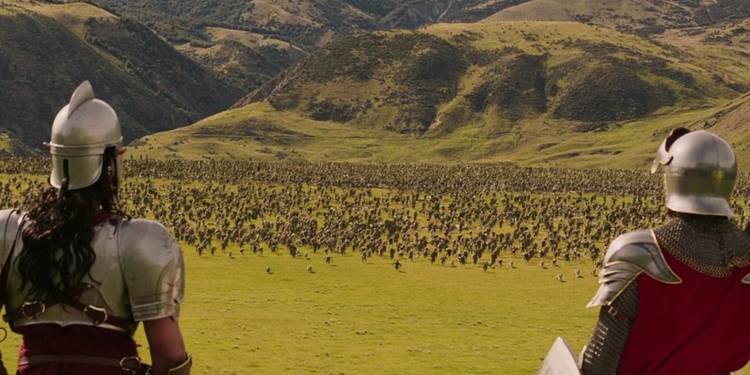
The scale of Narnia is adequately realized too. New Zealand of course makes for a terrific canvas, but also how the movie establishes the contours of its fantasy world very efficiently for a realm that contains not only traditional fantasy races, but talking animals, creatures from classical mythology, and of course -Santa Claus. Naturally, whimsy sweeps in here -it is a major component of C.S. Lewis’s writing after all, especially compared to his friend Tolkien. And yet there is still sufficient scale, the film feels like both children’s story and broad fantasy epic -this latter point largely due to some of that additional material, a somewhat darker attitude towards the Witch’s cruelty (such as turning Mr. Tumnus to stone after revealing Edmund’s treachery to him), and some strong writing where necessary. That is both a quality Narnia needed to work as a film at the time it came out and something that was somewhat demanded by the text, especially in trying to translate it for a more universal audience. Lastly, it is worth considering that while the film makes ample use of CGI, the WETA workshop does some great things with practical effects as well. Several creatures under the Witch’s command like the minotaurs are constructed of make-up and prosthetics, and creatures like Mr. Tumnus and the centaurs are a decent mix of both practical and CG effects. And unlike in Lord of the Rings, the film employs real little people for its smaller races like Dwarves -the Witch’s henchman Ginarrbrik played by veteran actor Kiran Shah -who was in fact Elijah Wood’s scale double on those films, now given the chance to show his face on camera.
 |
All this said, there are some pretty good reasons why the movie has dwindled in popular recognition compared to its peers. Though the script is broadly fine, there are moments of awkward dialogue especially in the bits meant to modernize the kids and add some humourous personality to the state of affairs. This I chalk up, perhaps from experience, to two of the film’s writers Christopher Markus and Stephen McFeely, for whom this was only their second screenplay (after strangely, The Life and Death of Peter Sellers). They went on to be the writers of both subsequent Narnia films before shifting gears and becoming the in-house writers for the Marvel Cinematic Universe and the Russo Brothers more specifically. And though tempered, their weaknesses are quite apparent here, whether in moments of lousy fake-outs -such as a brief bit where Lucy is believed to be dead- or in awful comedic bits like Peter forcing Edmund to wear a woman’s coat and most of the comic relief coming out of the beavers.
Related to said beavers, while I praised the practical effects where they are utilized, the CGI on the animal characters (and even some creatures like the fairy and the centaurs at a distance) is quite rough. The beavers look like animation characters for much of their screen-time and Maugrim, a wolf captain of the guard for the witch, looks like an early video game effect -and his lack of presence hurts several scenes, especially the confrontation between him and Peter. That whole scene in general is embarrassing -its purpose to showcase Peter’s active autonomy as a leader and his bravery in anticipation of a coming great battle that this teenager suddenly has to fight. Yet his slaying of an enemy beast that so convinces the good Narnians of his power as a future king is merely him raising his sword in front of him when an unconvincing Maugrim lunges, essentially impaling himself. I suspect that a concern over the image of cruelty to an animal may have prevented the creative team from playing it more authentically, but in this manner of execution both characters come off as incompetent, and there had to have been a better way to have staged such an important sequence. The only strange exception to the bad CGI alienation is Aslan, who looks no more tangible than the other characters at times, but because he is effectively the Jesus of this world it is much easier to take him not quite feeling real than it is a talking fox or a polar bear.
 |
As director, Adamson leaves very little distinguishing marks on the film and you can consequently feel a lot more of Disney’s creative and artistic oversight. Again it is especially apparent when you compare the movie to the Lord of the Rings or early Harry Potter films which had distinctiveness to the filmmaking, and strong artistic choices in service of more than just the story and visual effects. This Narnia movie has relatively few of those, as almost every beat is drawn in merely a functional manner. Sometimes it is what the moment demands and there are exceptions -the spell Mr. Tumnus begins putting on Lucy is one that comes prominently to mind. But largely the movie isn’t very ambitious in design, which in concert with those mediocre visual effects makes it a not particularly interesting movie to watch visually. And while Henley and Keynes make out pretty well for the most part, there is some notably more awkward acting from Moseley and Popplewell who give some pretty stunted deliveries of certain lines and emotions. For the latter it is not solely her fault. As stated before, Susan doesn’t have a lot of personality in this story and where the movie attempts to remedy that, the deficiencies of material and performance of it are only amplified.
For just about everything in this movie that holds up twenty years later there is something that doesn’t. It really is a product of its time, in all of its charms and shortcomings alike. Perhaps that speaks to how little its cultural relevance has lasted, how forgotten it is against the wider landscape of 2000s blockbusters. To this day one of its most famous attributes has nothing to do with the movie itself but is the fact it formed the basis for the first Lonely Island digital short on SNL. This in spite of the movie’s huge commercial success in 2005, its several accolades (including an Oscar win for Best Makeup), and two sequels in the following five years. The reception to those sequels may have taken some additional shine off, but the fact that they were made speaks well to how big this original movie was. And you know what, even just thinking back on them, I find myself appreciating this movie a little more.
 |
The Lion, the Witch, and the Wardrobe was an imperfect movie on release, but it was still something magical, and I only have to put myself in my adolescent head-space to see why. There is an irresistible charm to the whimsical simplicity of Narnia, not buried in the mountains of lore that other fantasy worlds feel the need to emphasize. There is a distinctness to the breadth of its magic, variety of creatures and lack of rules that is exciting, and which the movie captures pretty handily. It’s much the same thing that was so appealing in the original book. Perhaps there is something wise in the lack of danger that is truly felt for our heroes -who were always meant to be avatars for readers at various ages. I remember trying to see myself in Peter Pevensie (or Edmund in later books). And on that note, I can’t help but be transported by the ending back to a time of innocent childhood fantasy, that picture of oneself as great ruler of an imagined magical kingdom -and which this movie in its coronation scene encapsulates with a real kind of purity. C.S. Lewis responded to fantastical wish fulfillment in children perhaps better than any other fantasy writer has and this movie in a lot of the moments that count, embodies that perfectly. Certainly, it seems to have been understood by the actors -hell, even Adamson, who made sure neither Henley nor Keynes experienced the magical world they had constructed until performing their first scenes there themselves. The impact of this world on children is what mattered the most.
I think that may be the thing this movie offered that other fantasy blockbusters of its era did not, that almost primal sense of whimsical fantasy adventure for kids, and while it is there too in Lewis’s novel, this film really brought the magic to life in a more visceral sense. I hadn’t thought of how much the imagery from this movie has become intertwined in my mind with that of the Chronicles of Narnia more broadly as I read them in my youth. There is some power to that, and with the various shortcomings the movie does have, its dated materials, it is fortunate it did get made in the time that it was. Much as I have considerably more faith in Greta Gerwig as a filmmaker and her vision for this series, the shape of the industry now and the powers that be in Hollywood (and especially Netflix) give me doubts these new films will attain that similar degree of magic (certainly not if they’re mostly shot against a green-screen) or earnestness of spirit.
With the distance of twenty years, The Chronicles of Narnia: The Lion, the Witch, and the Wardrobe reveals more scratches and flaws than nostalgia gives room to, but is also more solidly a gem of a fantasy film. It was the last major work in the genre before Game of Thrones redirected its popular tastes towards the adult and the Hobbit movies shifted the more rootsier elements away from the tangible. An important artefact of a movie; obscure though it may be, it’s magic is still alluring. As much as a lamppost in the middle of the woods.

Support me on Patreon: https://www.patreon.com/JordanBosch
Follow me on Bluesky: https://bsky.app/profile/jordanbosch.bsky.social
Letterboxd: https://letterboxd.com/jbosch
Twitter: https://twitter.com/Jordan_D_Bosch
Comments
Post a Comment