Why have I now seen two fondly remembered Christmas movies with uncomfortable scenes of blackface in them? And why is one of them from the goddamn 1980s??
Like most of John Landis’s movies from this era, Trading Places has a handful of scenes and a few thematic threads that are frustrating or have aged poorly -unfortunate marks on a premise that in this case is actually very good and interesting. A satire of class and wealth that feels like a piece by Mark Twain adapted by Preston Sturges based around the singular concept of a rich man and a poor man swapping class status. Some form of it had been seen before but never in this precise manner or with this slickness, and it is perhaps the optimal example in American cinema. I wasn’t aware of how much influence it had on this year’s Good Fortune for instance -which is basically the same plot but with an Angel and magical intervention thrown in (and maybe more direct consciousness of the reality of wealth disparity). For as interesting and novel as the movie’s core idea is, there is more going on there -it speaks very emphatically to its audience of the 1980s, though perhaps not as honestly so as it might.
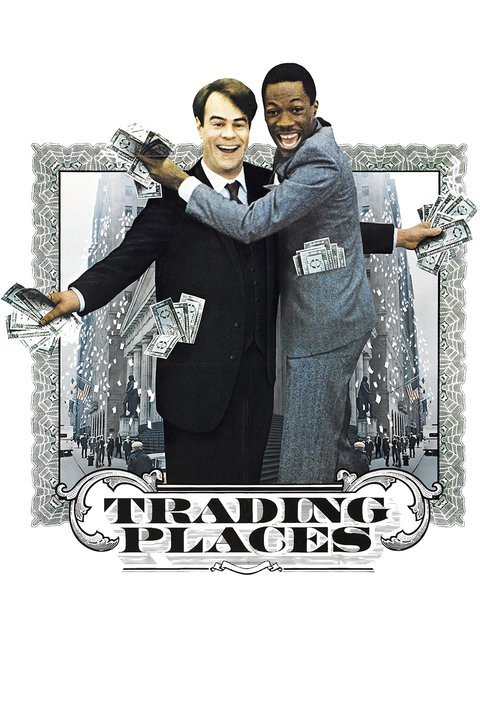
Set primarily in Philadelphia, the point-of-view characters for this story initially appear to be a pair of rich old commodities brokers called the Duke Brothers, played by a pair of classic cinema veterans -Ralph Bellamy and Don Ameche. Though both are heinous, greedy capitalists, they are set apart by slightly different philosophical views of the nature vs. nurture debate when it comes to sociology; Bellamy’s Randolph believes in the latter while Ameche’s Mortimer believes in the former. They decide to test this out with a bet, using as a pair of guinea pigs a wealthy promising young white man in their firm Louis Winthorpe (Dan Aykroyd) and a homeless black street hustler Billy Ray Valentine (Eddie Murphy), who is accused by Winthorpe of trying to rob him in an accidental scuffle. The Duke brothers proceed to bail Valentine out of jail, provide him a house and possessions, and install him in their firm with a high salary and degree of responsibility. At the same time they arrange to ruin Winthorpe’s life, framing him for robbery and drug possession, kicking him out of his house, freezing out his bank account, and sabotaging his romance with their grand-niece.
While the movie does intend some level of sympathy towards Winthorpe as all of this is happening to him, its other effect resonates much more. It may not have been wholly welcome in Reagan’s America, but it is now quite cathartic to see a pretentious, implicitly racist rich man lose all the status and connections he cares about while being forced onto the streets he looks down upon so pompously. Likewise it is nice to see somebody like Valentine, crushed under the weight of an arbitrary unfair system raised out of poverty and get a chance to prove himself as greater than he is judged. Mortimer, the more bluntly racist of the pair, is delightfully proven wrong very quickly by how swiftly and efficiently this struggling black man is able to grasp and understand their work -better than they do in fact. It is a very good encapsulation of the fiction that is meritocracy and a sly denunciation of the conservative bootstraps mentality, as we see how despite how competent he is, Valentine needed to be lifted into this position and social strata -he had no way of getting there otherwise.
Nonetheless, there is still something of a Reaganite mentality to the film in how the world of Winthorpe and the Duke Brothers is presented as inherently desirable and there are very few virtues in Valentine’s character owing to his struggle. His homeless lifestyle is of course presented as a caricature, even more so when Winthorpe is forced into it. And the movie of course has nothing to say about the systemic roots of the American wealth gap, which of course was truly beginning to widen during this time, instead consolidating all issues in the machinations of two individual rich bad guys whom the film gives no indication are representative of commodities brokers broadly. Getting back at them is the only thing that matters, and neither Winthorpe nor Valentine could care less about the wider issue of social inequity.
This is emphasized to some degree in how they are able to join forces once Valentine learns the Dukes plan to deposit him back into poverty now their experiment has run its course. Temporarily situating Winthorpe on the low rungs of society, in which capacity he still finds himself privileged enough by his former status that a sex worker Ophelia (Jamie Lee Curtis) provides him a place to stay on condition of eventual financial reward, is supposedly enough to make him an underdog too. But Valentine and Winthorpe’s past history is ignored in their becoming partners, not to mention the underlying veil of racism that motivated Winthorpe’s prosecution of Valentine to begin with. It is as though Winthorpe being taken down a peg in terms of wealth and class absolves him of his other character flaws, or Valentine is able to wholly look past them -neither of which is ideal for the formation of a friendship.
Of course I understand this comes with the necessity of pairing Aykroyd and Murphy in a classic buddy dynamic. At the time it was beneficial to both. Aykroyd was in a bit of a career slump following the death of his comedy partner John Belushi, while Murphy was rapidly on the rise as the most successful comedian in America. Aykroyd needed the cool and legitimacy of being paired with Murphy while Murphy benefited from the perceived blessing of an elder comedy veteran. You can sense in their scenes together a certain disconnect -they don’t have much room to grow their chemistry (partly due to a sequence of elaborate facade that takes up a sizeable chunk of their screen-time together). They work much better as parallels to one another than as partners in crime. Yet it is clear by their subsequent work through the 80s that the arrangement worked out.
Not without some baggage though. I don’t know whether it is they or the film’s screenwriters who are to blame for the baffling train sequence in the third act, which apart from being tasteless on multiple fronts is just a wholly random series of events to throw these characters into just to steal a report off a spy played by Paul Gleason. Valentine’s disguise is so transparently an excuse for Murphy to play one of his stand-up characters, and I hope the same was not true of Aykroyd playing Jamaican -but it’s a gag that otherwise can’t possibly exist for any other reason than the mere comic novelty of Dan Aykroyd in blackface, mimicking a Jamaican accent. Considering Winthorpe’s own racist proclivities it is all the more stupefying. It feels dramatically out of step with the rest of the movie, and the fate of Gleason’s character even more so -forced into a gorilla costume and then assaulted by a real gorilla as Al Franken watches; it’s textbook overkill for a minor villain that screams adolescent shock value for its own sake. Landis could maybe get away with that in something more openly sophomoric like Animal House, but here it’s just painful and aggravating.
How Winthorpe and Valentine’s revenge is ultimately taken after this dreary detour, is much smarter and more in keeping with the sensibilities of this screwball premise. An elaborate con by the pair using their insights of the commodities trade to trick the Dukes into investing heavily in orange juice futures contracts (agriculture being their primary racket) and short-selling similar contracts on the stock market trading floor off of this lead, only to buy them back for less than they sold after a crop report predicts no shortage. Locked into their contracts, the Dukes are financially ruined while Winthorpe and Valentine have cheated their way to fortune -a pair of rich assholes get their comeuppance to be replaced by a couple others -Winthorpe fully in the ‘good rich guy’ category it seems. It is still a pretty well-executed comic climax, frantic and a little unclear though it may be at times, it is sharp and energetic, and rounds out the story nicely -exactly the kind of zany resolution such a premise deserves, down to Winthorpe and Valentine mocking the Dukes’ minuscule bet in their victory lap. And of course in the most cliché of endings they are next seen on a tropical beach, Ophelia having fully replaced the fiancee Winthorpe lost early into his misfortune.
It tries very hard to convince you that all is right with the world. A good and enjoyable ending for the story, but glaringly shallow for the sake of the satire. Trading Places is an okay movie that is prevented from being great not just because of its offensive shock jock bits, but because it doesn’t look beyond the narrowest contours of the premise it explores. The moment Winthorpe and Valentine start working together is where the movie loses its actual edge, with the issues of class, wealth, race, and privilege blurring away as the intended thematic idea is lost in the haze of the Duke Brothers being the source of all problems. As though the movie had to immediately compensate for getting a bit too questioning of capitalist power structures, so that rather than being a movie about the arbitrary inequities in the American economic divide it is about two guys -white and black- who get rich pulling one over on the pair of eccentric stockbrokers who tried to ruin their lives. It goes from being critical of corporate America to discreetly celebratory of it; and that dissonance alone is enough to temper one’s feelings towards the film, whatever their own opinions are of the system.
Trading Places is the kind of movie I would like to see remade by someone like a Boots Riley -Good Fortune was good, but the angelic side of it keeps it from being quite the same scenario. The concept is still very engaging -I think that alone is honestly what has kept the movie’s reputation and its influence. It’s suggestive of something smarter, more relevant and funnier than a Hollywood studio comedy in 1983 was perhaps even capable of.
Support me on Patreon: https://www.patreon.com/JordanBosch
Follow me on Bluesky: https://bsky.app/profile/jordanbosch.bsky.social
Letterboxd: https://letterboxd.com/jbosch
Twitter: https://twitter.com/Jordan_D_Bosch
Comments
Post a Comment