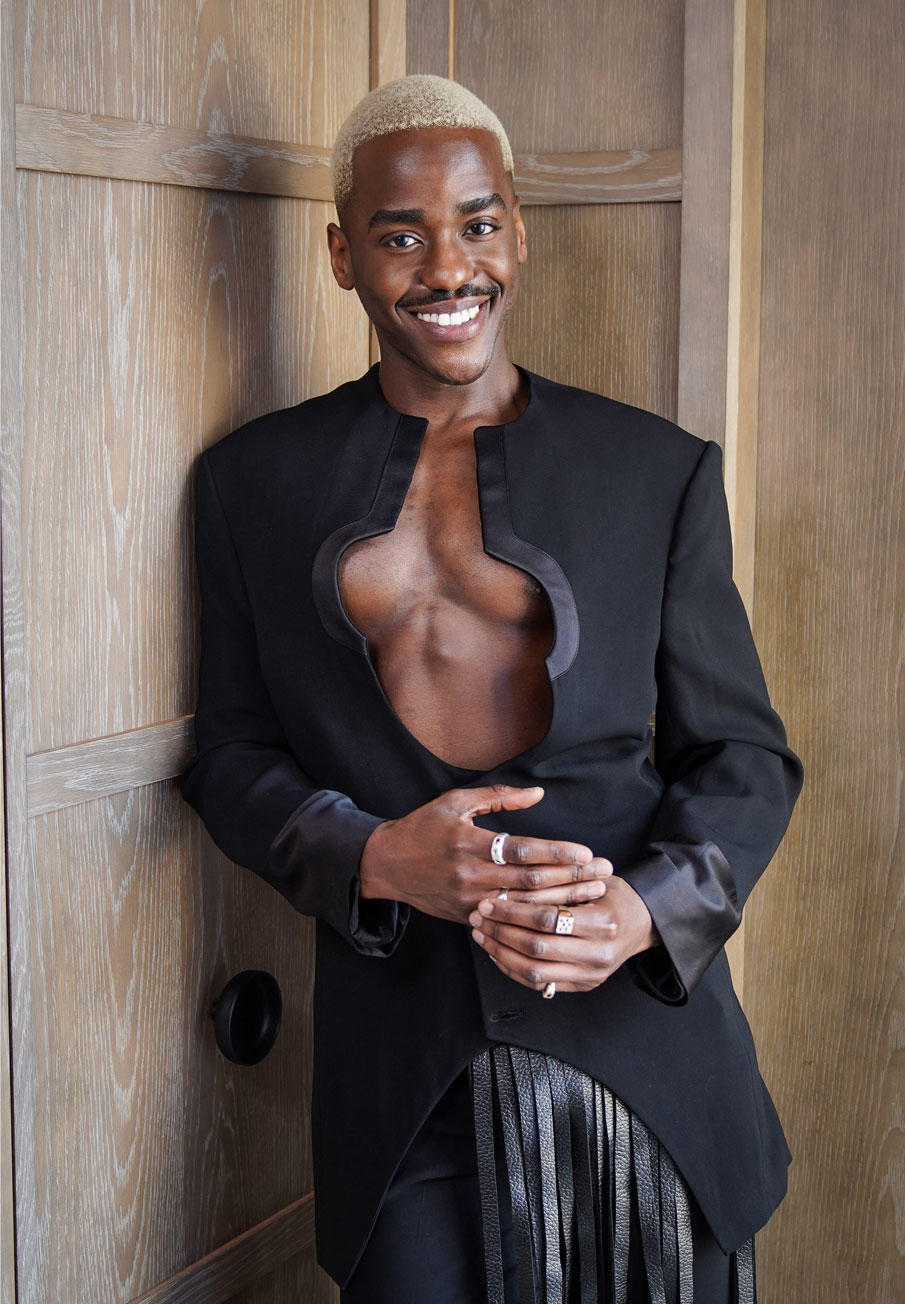
It is official! I was wondering when the announcement was going to come; with just one episode left for Jodie Whittaker, it was getting late, and there was no way the modern media would let that alone be the reveal for her successor. But here it is, on Mothers’ Day the news dropped.
Ncuti Gatwa is going to be the Fourteenth Doctor! He will headline Doctor Who going into 2023 under the stewardship of Russell T. Davies, back in the showrunner job for the first time in thirteen years. He will become the latest face of one of the grandest sci-fi media franchises in the world. And so it begs the question, who is he?
Unlike the last two Doctors, both of whom had fairly significant resumes under their belt in film and television, Gatwa is a less-established entity, on par perhaps with Matt Smith when he was first cast. Although unlike Smith, Gatwa does have at least some kind of profile off of the Netflix coming-of-age series Sex Education, on which he plays Eric, the best friend of Asa Butterfield’s lead character. And in fact he’s been nominated at the BAFTAs and several other British Awards outlets for this role. It makes me curious to see the show, get an idea of his performance strengths.
Gatwa is one of the youngest actors to take on the role of the Doctor -just a little older than Smith and about the same age as Peter Davison when he first played the part in 1981. In fact he’s the same age as me, which is probably going to be a little jarring at first. Nothing at all wrong with that, though I do miss the days when mid-aged actors could play the part and the Doctor didn’t necessarily have to be a sex symbol (I am aware Peter Capaldi was just two Doctors ago). Because one thing’s for sure off of those pictures that have been circulating by the press reporting this: Gatwa will be a very sexy Doctor.
But most importantly, most inevitably, Gatwa is the first black Doctor -at least the first that really counts as the lead of the show, with all due respect to Jo Martin and her enigmatic “Fugitive Doctor”. There was almost no way the Fourteenth Doctor wasn’t going to be a person of colour. After breaking the gender barrier in 2017, the show needed to break the racial one too -affirm that the Doctor really can be anyone. I would imagine the response isn’t going to be as toxic this time around (although I’m prepared to be surprised); the Doctor changing race doesn’t seem as contentious an idea in this community as changing sex -that pushback against Whittaker is still pretty visceral and malignant in the fandom. But it’d be naive to think Gatwa is going to have an easy time of it. If his attitude in red carpet interviews on the day of the announcement is anything to go by though, he is up to the challenge and I wish him the best of luck.
A new face for Doctor Who is always exciting, perhaps even more so when it’s someone so fresh and unexpected. I can’t wait to see what his costume looks like, what his TARDIS will look like, and what he will bring to the show in a run already full of anticipation due to the return of Davies. Until then we still have Jodie Whittaker’s swansong later this year to wrap things up and set the stage.
Next year is Doctor Who’s sixtieth anniversary. I’m pumped for whatever Davies has planned around that. And it’s ample time to regenerate the show with a new face unlike any the series has had. Ncuti Gatwa will not only be joining, but reshaping that legacy. It’ll be a thrill to see!
Support me on Patreon: https://www.patreon.com/JordanBosch
Follow me on Twitter: https://twitter.com/Jordan_D_Bosch
Letterboxd: https://letterboxd.com/jbosch/
Comments
Post a Comment