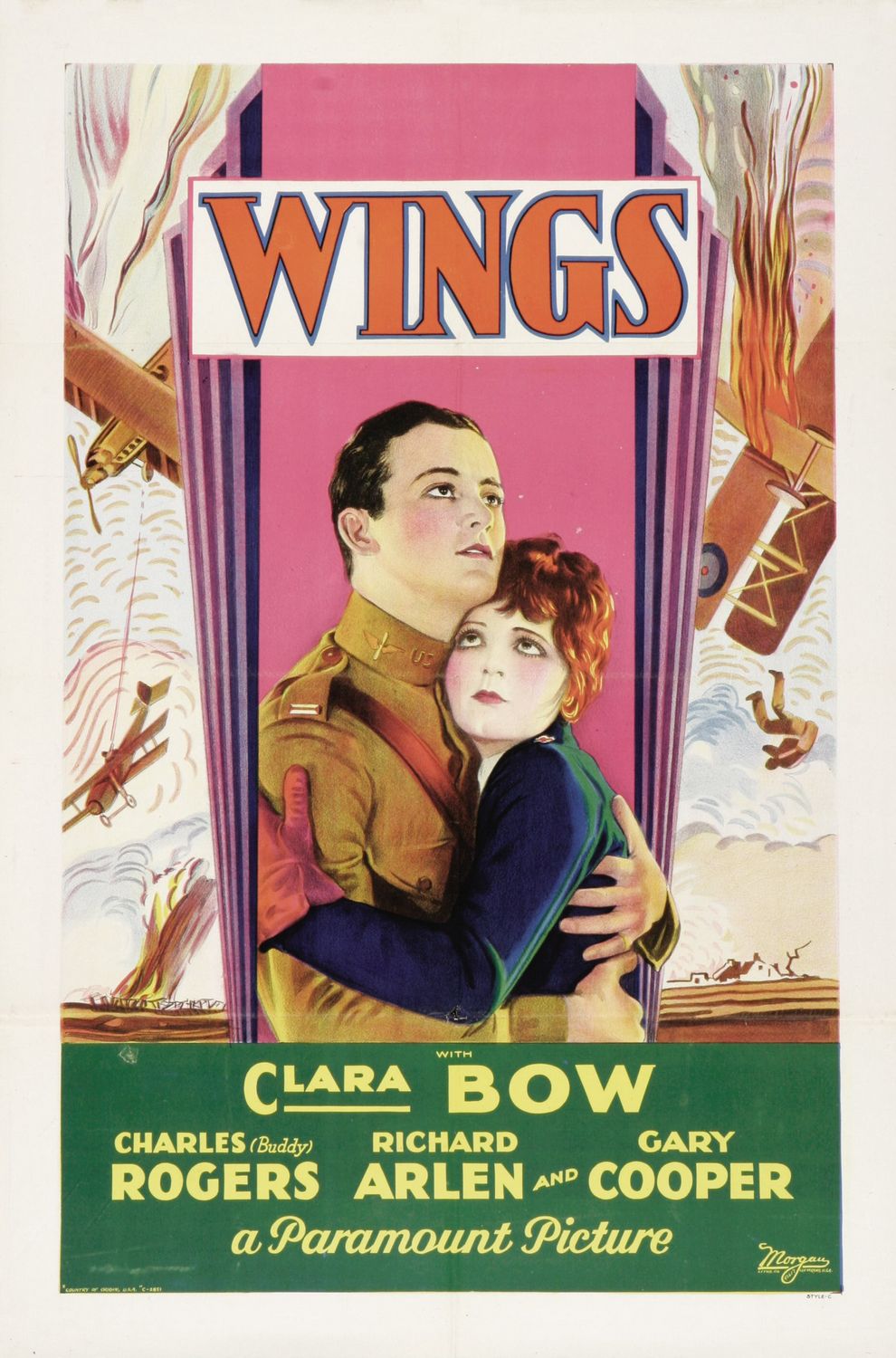
Set during the First World War, Jack (“Buddy” Rogers) and David (Richard Arlen) are a couple small town boys competing for the same girl (Jobyna Ralston) before being shipped off to Europe together. Meanwhile, Mary Preston (Clara Bow), another local girl, has unrequited feelings for Jack. While she works as an ambulance driver in the war effort and he makes a name for himself as a flying ace, the two are destined to cross paths.
The difficult thing when reviewing silent movies is that it’s almost another medium and so the standards of quality are quite different. And because of the time period in which it was made, certain trends in writing and acting need to be taken into account. With that in mind, Wings is definitely one of the better silent dramas I’ve seen. It has nothing on the best of German cinema at the time and as a matter of preference I just happen to like silent comedies better. But this movie did a few things to impress me. For one thing, the dogfights and battles are shot very well for the time looking like genuine war footage. This must have had a fairly decent budget. The music is also fairly good -not lazy but also not bombastic enough to be distracting. This movie is also pre-Hays Code meaning it got away with stuff that later films couldn’t. There’s some violent imagery (though nothing compared to All Quiet on the Western Front a few years later) and even brief nudity on Bow’s part. It is unusual seeing stuff like this in an old movie and I appreciate that. On another interesting note, there’s a scene where Mary tries to get Jack’s attention while drunk, and the portrayal of the effects of alcohol are fairly exaggerated, maybe in concordance with the law at the time, this movie having been made in the middle of the Prohibition period.
And then there’s the casting. Rogers and Arlen definitely perform their parts in the over-the-top manner of the period, but are okay if a little bland at times. None of the supporting cast stand out though, even Ralston isn’t given much to work with. Gary Cooper’s also in this film, one of his earliest roles and as far as Cooper is concerned, he’s fine. It’s kind of funny that he’s sometimes advertised as a big supporting player in this movie, but his screen-time amounts to what would be a cameo is he were a bigger star in the late 20’s. The best performance in Wings is actually Clara Bow. Hollywood’s first “It girl” is not often remembered for being a good actress, especially compared to her contemporaries like Mary Pickford and Greta Garbo. She was always more of a cheerful pretty face and sex symbol, but in this movie she’s quite good. She plays the lovelorn innocent well enough you sympathize with her (it also helps that Jack’s kind of a jerk around her), but also relates well an enthusiasm for doing her part in the war. She’s the only character who feels like a character, with more a distinct personality and mannerisms. But despite her star billing it’s a shame, this being a male-dominant war movie, that she’s absent for a few long stretches and her arc just kind of stops.
In many respects, this movie doesn’t age well. For one thing, the main story fails to be interesting, and the change in focus from the rivalry between Jack and David, to Jack’s enthusiasm to be an aviator doesn’t come across naturally. I was surprised how quickly they became friends, and while I admire the films’ efforts to relate their friendship (even to the degree of a probably unintentional homoerotic connection) it’s not an engaging plot thread. It also suffers from being a very typical story, which on the one hand I understand; this was still the early days of cinema, but they could have put some unique spin on the love triangle war story. The ending comes out of nowhere too. Jack though he’s shunned Mary the entire movie, never showing signs he loved her the way she loved him, decides in the last scene he’s over the moon for her and they have a happy ending. It’s absolutely bizarre and feels like an incredibly lazy avoidance of character development. And there are some silent movie traits I can’t quite reconcile, as open as I am to the form. The use of title cards wavers in its effectiveness; sometimes knowing to hold back on them and let the performance suggest the language and tone, other times they’re seemingly wasted on pointless affirmations like “Yes”, or Jack’s drunken insensible words, and then there are moments when they should be used but aren’t. I don’t mind the faster pace, the film often being sped up a degree, but the constant cuts to the same shot can be quite distracting. And in that aforementioned last scene, the tint of the movie suddenly and very noticeably changes from golden to blue. To be honest this is probably not the filmmaker’s fault and may just be an error on the film itself and thus the DVD I watched it on, but it bugged the hell out of me!
Additionally, this movie has a clear patriotic streak. The title cards referring to the brave soldiers really emphasize how great an honour it is to fight for America. In a sense, this is to be expected: director William A. Wellman, and Richard Arlen were not only veterans of the First World War, but had appropriately for this film, been fighter pilots. Emphasis is placed on how noble these young mens’ intentions were, and I was a bit taken aback that while like All Quiet on the Western Front we see the anxiety and immense sense of duty in the young heroes before they go off to war; the horrors of war itself aren’t as apparent. At least not until the end, and even then, it feels like the movie justifies it. This is definitely a war movie about heroism over harsh truth, which doesn’t quite work anymore. At least something like Billy Bishop Goes to War, a similar story about a cocky flying ace, balanced the heroics out with the tragedy.
The overt patriotism to the point of propaganda is just one of a number of factors that don’t make Wings the great film now that it was when it won its historic Academy Award. It’s not a bad film by any means, but is just an okay movie, not quite as timeless as other films of its era. It is fascinating though to see what kind of film the very first Best Picture winner was, and it speaks a lot to the mindset of the American people at the time. This was after all, less than a decade after the war they’re portraying ended, and so it makes sense that people would want a more polished up version to ease their minds. It’s worth watching if you’re curious about this legacy it has, and if you’re a fan of Clara Bow and want to see a pretty good performance from her, as well as some well-shot air battles. But as Oscar Best Picture winners go, in 1927 the best was certainly yet to come!
Comments
Post a Comment