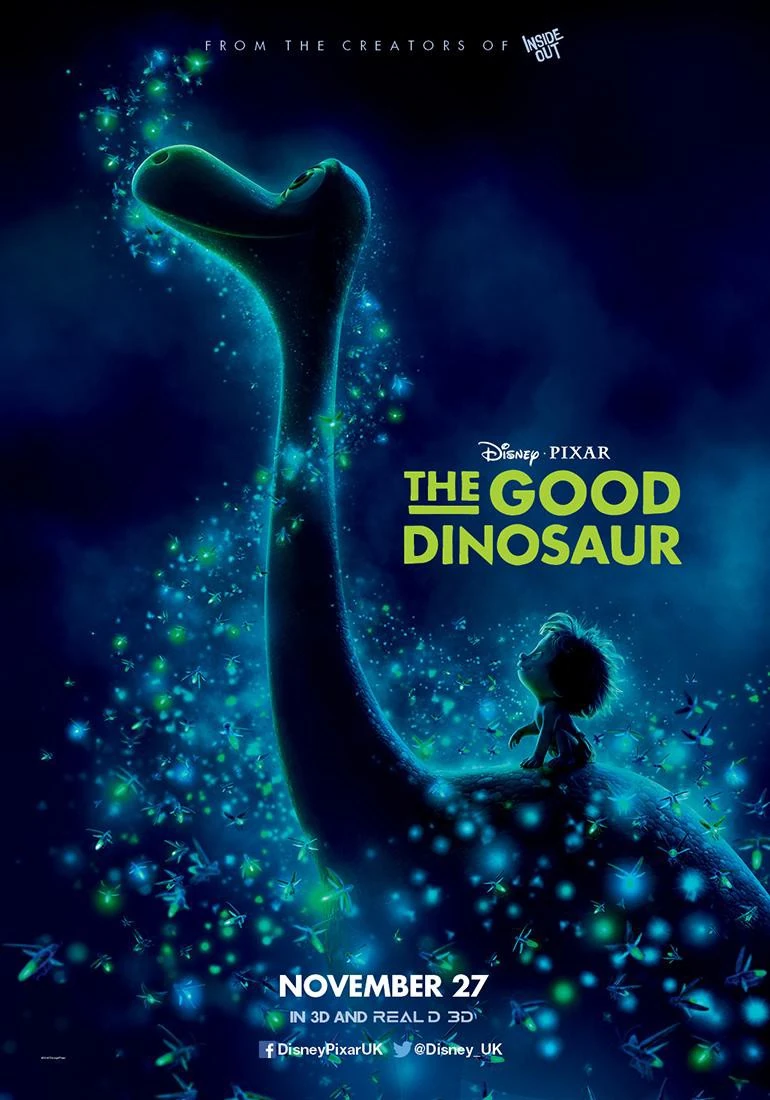
When I saw the first teaser for The Good Dinosaur I was excited! It
looked bold, clever, and visually magnificent. There was no dialogue, and the
set-up seemed promising. Pixar already made a comeback with Inside Out (still the best film I’ve
seen this year) and now it looked like they would be upping their game even
more. Now I’ve been to see it and it’s …okay.
The premise depicts a world in
which dinosaurs never went extinct and over millions of years evolved up to the
point when humans came along. The story in this set-up follows a young
Apatosaurus called Arlo the weakest in his family, who gets lost after a
personal tragedy, and with the help of an infant human he names Spot, tries to
find his way home again.
It sounds like a familiar
set-up, which it is; and which is the biggest problem of The Good Dinosaur. The prehistoric-creature-must-find-it’s-way-home
story has been done a surprising number of times and it hasn’t been done
excitingly or fresh since The Land Before
Time. Even having a child along for the journey and characterizing that
child as pet-like isn’t really new. Throughout the film I was hoping it would
go in some interesting directions with this, but it’s fairly straightforward
and predictable. Which is a shame because given the context of this world,
where dinosaurs have evolved to talk, rationalize, and irrigate, there are so
many greater possibilities and stories to explore, rather than focus just on
this story and relationship that’s been done and done better in the past. The
characters aren’t very interesting and don’t develop in unexpected ways. A lot
of elements in this film feel borrowed from The
Land Before Time, key among them being how Arlo is no different from
Littlefoot. He’s just as naïve, just as fearful, just as much an underdog, and
develops his courage and determination at a very similar pace. Spot is every
excitable, energetic, loyal-to-a-fault, primal kid type. The only characters
with some creativity to them are the side dinosaurs we meet along the way. They
include a gang of suspicious pterodactyls, a family of tyrannosaur rustlers led
by a brilliantly cast Sam Elliott, and some raptors on the loose from the set
of Deliverance. The scenes with these
characters in particular make the film feel like a western which I admit gives
it a unique if odd characteristic.
The
saving grace of the film however is its animation which is very pretty.
Particularly the landscapes look right out of a nature documentary (and one set
in our own Canadian backyard at that). Though I feel at times it’s too
photorealistic, so that you forget the film is animated which I think distracts
from the art of animation oh a whole. But the panoramic shots like in the
trailer, are wonderful and lend a sense of grandness to the world and the
firefly sequences are captivating. The characters are also very distinctly
designed and expressive, enough so that I do really think this film would have
been better without dialogue. That was the impression the first teaser gave me
and I think this film could really have been remarkable if it was purely
visual. Another interesting aspect is how dark the film is. The situations are perilous and grim even
though we know the outcome. When the inevitable tragedy occurs, I was surprised
how unrelentingly swift it was, and it left a suitable impact.
There
are definitely some good moments in The
Good Dinosaur and the animation is wondrous, but it does suffer from a
bland story and characters that feel like a waste of a promising set-up. It’s unfunny,
unoriginal, and tries too hard to be cute and emotional. But it tries harder
than the Ice Age movies. If you’re
curious, I’d recommend it only for the visuals; and for the short in front of
the film called "Sanjay's Super Team" which is a vibrant display of colour and creativity, much better than
the film that succeeds it.
Comments
Post a Comment