It’s that time of year again when the spooks and ghouls
come out of the closet....to scare! Halloween is a great time for entertainment, with so many
great film and television specials around the holiday. But when they’re
animated, they have a harder time being effective due to the distance animation
generally seems to have from real life and thus is less accessibly frightening.
But there are some that have broken the mold. And now it’s the time to re-watch
some terrifying animated Halloween classics like Disney’s Legend of Sleepy Hollow, The
Nightmare Before Christmas, Casper,
Over the Garden Wall…wait what?
Yeah
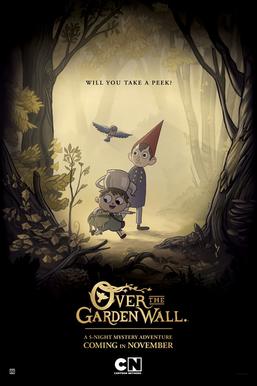
surprisingly last year’s Cartoon Network miniseries Over the Garden Wall, which
just won the Emmy for Outstanding Animated Program, I think may be a perennial
classic. It really has the makings of one and I hope it achieves that status
because it’s a terrific miniseries that’s inspired, atmospheric, funny,
fascinating, visually marvellous, and most importantly for Halloween,
frightening!
The
series comprises of ten eleven minute episodes (so it’s easy to binge watch),
and follows two step-brothers Wirt (Elijah Wood) and Greg (Collin Dean) making
their way home through a mysterious woods called the Unknown encountering
bizarre characters, strange places, and adventures along the way. It was
created by former Adventure Time
writer and director Patrick McHale who pitched it as a pilot before reworking
it as a miniseries of vignettes with a focus on being a spooky adventure into
Americana.
The
series is heavily influenced by American folklore which gives it a rich
atmosphere and look hearkening back to the writings of Washington Irving and
Nathaniel Hawthorne. But various episodes also borrow elements from Beatrix
Potter, and Edgar Allan Poe (oh yeah, and one’s an homage to The Wicker Man!). I love this for a few
reasons: first I think Irving’s work in particular should get a lot more
attention than it does, second because this very specific tone really works to
its advantage as a Halloween series, and third I love animation that draws on
folklore for creativity –it’s what made me fall in love with Song of the Sea, which this series has a
lot in common with. And in a way, the folkloric style gives it a timelessness.
There’s no modern cultural references and the character designs even from
(especially from) our two leads don’t place them in a particular time either.
What
also makes this a classic is how original it is. Yeah when it comes to
characters, Wirt and Greg are fairly pedestrian: Wirt is an awkward geek who
resents his step-brother Greg who is a free-spirited wildcard (think Mabel from
Gravity Falls crossed with a Minion).
But their outfits are strange and different enough to grab your attention (Greg
wears a teapot on his head for most of the series while Wirt seems to be
dressed like a wizard), and after a while even their formulaic personalities
grow on you. And they’re also surrounded by some great supporting characters
like a strangely endearing talking bluebird called Beatrice (Melanie Lynskey), a
mysterious Woodsman (Christopher Lloyd), and a cast of eccentrics with voice talents
like John Cleese, Tim Curry, Shirley Jones, Bebe Neuwirth, and famous “that
guy” Fred Stoller. But the creativity comes best in the story which has a lot
of thought and effort behind it. The overarching mystery surrounding the woods
and the characters takes some unexpected twists keeping you questioning where
it’s going …and where it’s coming from. The series opens up fairly in media res
with only a little exposition to set up the plot, so you wonder what the story is
behind these two kids wandering around in these woods (or even why it’s called
“Over the Garden Wall”?). I love that it keeps you guessing, and very much lets
the tone and look progress the story. It admittedly doesn’t have a spectacular
first episode, but its odd magnetism does grip you and organically lets you settle
into the story, visuals, and sense of humour.
Like Adventure Time a lot of the comedy of Over the Garden Wall is very surreal, but there’s a little more
direction behind it. Some of the jokes and visual gags really work while others
are just odd and nonsensical. A lot of it comes from Greg whether or not it’s
successful. Some of the random humour and songs aren’t funny but still
fascinating to watch (John Cleese voices a couple characters who are of course
hilarious). But while the humour seems at the forefront of most of the
episodes, you can tell this isn’t exactly meant to be a comedy. Some of it is
there to appeal to a younger audience, some out of legitimately funny writing,
most just to relate an innocent charm, but its main purpose seems to be as a
contrast to the dark visual style.
The visuals are very
interesting too. Again McHale’s background is in Adventure Time and there’s definitely some of that show’s animation
style at play in the exaggerated expressions and motion. At the same time the
abstractness of some of the art and fine detail in the environment, the
animation reminds me in some ways of Cartoon Saloon and particularly Song of the Sea. But there is a
uniqueness especially in the dark colourizations and use of shadows to reflect
the mood, and when they need to be creepy, they are very creepy! Speaking of
which, the animation can really capture some terrifying sequences.
Yes,
for a Cartoon Network series this show is genuinely scary. The whole story has
some creepy parallels to Dante’s Divine Comedy with the mood allowing for some
darker ideas. Throughout the story, Wirt and Greg are evading an antagonist
known as the Beast who strikes terror even in just his silhouette. His evil
machinations are all the more frightening. There is marvellous music and
fantastic use of suspense as well as continuity with characters and their
connectedness with the overall story. And the imagery is downright terrifying.
There’s a moment in episode seven that’s one of the most terrifying things I’ve
ever seen in animation. And again the use of creativity, detail and shadows
really works to this effect. The fact you can’t wrap your head around where
it’s going and the constant mystery keeps you on guard. The horror is somewhat
downplayed in the early part of the series but by that last stretch of
episodes, it’s serious goosebumps time (beware once you start hearing about
Auntie Whispers). It’s a truly frightening series which definitely makes it a
must-see around Halloween.
Over the Garden Wall really deserves to
be a Halloween classic, succeeding in being genuinely scary as well as telling
an interesting and original story in a compelling environment, an incredible
atmosphere, with great animation and humour and all inspired by American
folklore and legend: the source of so much great horror. For me not only is it
going to be a perennial classic, but it’s one of the most clever and
fascinating animated series in recent memory. It’s really a shame it was only a
one-off as I can see it becoming a terrific annual anthology with new stories
being told in the Unknown. But maybe I just want to see what Patrick McHale
does next. It deserved to win its Emmy and more than that, Over the Garden Wall deserves to be seen by more people around this
time of year who’re looking for just about everything you could get out of a
Halloween special!
Comments
Post a Comment